Friday, November 29, 2013

Botany picture #123: Bauera rubioides


Bauera rubioides (Cunoniaceae), Tasmana, 2013. This species appears to be extremely widespread and common across Tasmania but we saw it most frequently on the more heathy margins of rainforest areas where it would form large tangles. The flowers are all hanging downwards, making me wonder who the native pollinators are. Whatever the case may be, I assume that the introduced bumble bees will not have any problem with them.

Thursday, November 28, 2013

Inflation in citation metrics

On Jeffrey Beall's Scholarly Open Access blog I recently got involved in a short discussion on steadily rising citation metrics. He discussed a citation metric that he considers suspicious, and one of the reasons he mentioned was that it always seems to be going up. It is well possible that the metric in question is manipulated - or not, I would not know and have no opinion either way - but it is important to realize that some degree of inflation is unsurprising and not necessarily, on its own, an indication that something is off.

The most highly regarded of them all, the Impact Factors (subsequently IF) from Thompson Reuters' Journal Citation Report, show the same trend. Yes, there are some losers and a lot of stagnation especially at the lower end of the spectrum, probably because the editor of a very small journal is only willing to invest so much time into it, and if you only compare across two years or so you will get a lot of noise. But if you take a bunch of decent, mid to high level journals from my field and compare their current IFs with what they had a few years back you will see slight increases very nearly across the board.

Here a few semi-randomly chosen journals from my field and their change over five years - meaning I looked up the IF 2007 and 2012 for a few well-regarded journals whose names immediately popped into my head:

Am. J. Bot. +0.074; Aust. J. Bot. +0.217; Aust. Syst. Bot. +0.488; Bot. J. Linn. Soc. +1.514; Flora +0.559; Folia Geobot. +0.432; Syst. Bot. -0.345; Taxon +0.258; Trends Plant Sci. +2.813

The only one bucking the trend here is Systematic Botany, which does seem to have moved from publishing a lot of phylogenies to a lot of alpha taxonomy lately, and the latter unfortunately and unjustly does not bring in a lot of citations. Conversely, the Botanical Journal went up a lot since they stopped accepting purely alpha taxonomic papers and they published the last Angiosperm Phylogeny Group update, a landmark paper that was guaranteed to get a ton of citations. Trends also looks like it got a big increase but it is not that much relatively speaking; as a review journal it was always by far the highest on this short list.

So how is that possible? Why do the citation metrics appear to consistently increase over the years? Is there some manipulation going on?

Wednesday, November 27, 2013

Botany picture #122: Ozothamnus reflexifolius


Unsurprisingly I now have a number of plant photographs from Tasmania that I am going to use for botany picture posts in the next few weeks. We start with Ozothamnus reflexifolius (Asteraceae), a shrubby daisy that is known from only one population on a hill flank near Hobart. I has only been described as a new species a few years ago. Being so rare and vulnerable, it is good that the Royal Tasmanian Botanic Gardens have it in cultivation, and that is where I took this picture. I was extremely happy that I was able to see this plant during my visit.

Tuesday, November 26, 2013

When should we admit that somebody is perhaps a bit stupid?

Going through the newspapers that have accumulated while we were away, I came across this little piece in the Guardian on women supposedly going off contraception because it is too bothersome. The commenters on the online version have raised issues with argumentation from anecdote but that is not what immediately occurred to me.

Saturday, November 23, 2013

Tasmania, part 5: back in Hobart

Vacation is over. For the last few days we came back to Hobart and explored the area around it a bit more. The following is then not about landscape but about tourist attractions.


One day we spent at Margate. The Inverawe Native Gardens pictured above are not really a botanical garden in the strictest sense but a landscape garden run by a retired couple. Because it was raining all day, they looked somewhat surprised that they had any visitors at all.
 

As the name indicates, the garden has a focus on Australian native plants but in addition there is much information on early explorers of the area and on the earliest botanists. There are also timber samples, poems on nature and gardening to be read, and various whimsical pottery sculputures ranging from elves across the snails depicted above to weird hands sticking out of the ground.


Something for everyone I guess. We were of course mostly interested in the plants. The above are the beautifully spotted flowers of a Prostanthera (native mintbush, Lamiaceae).


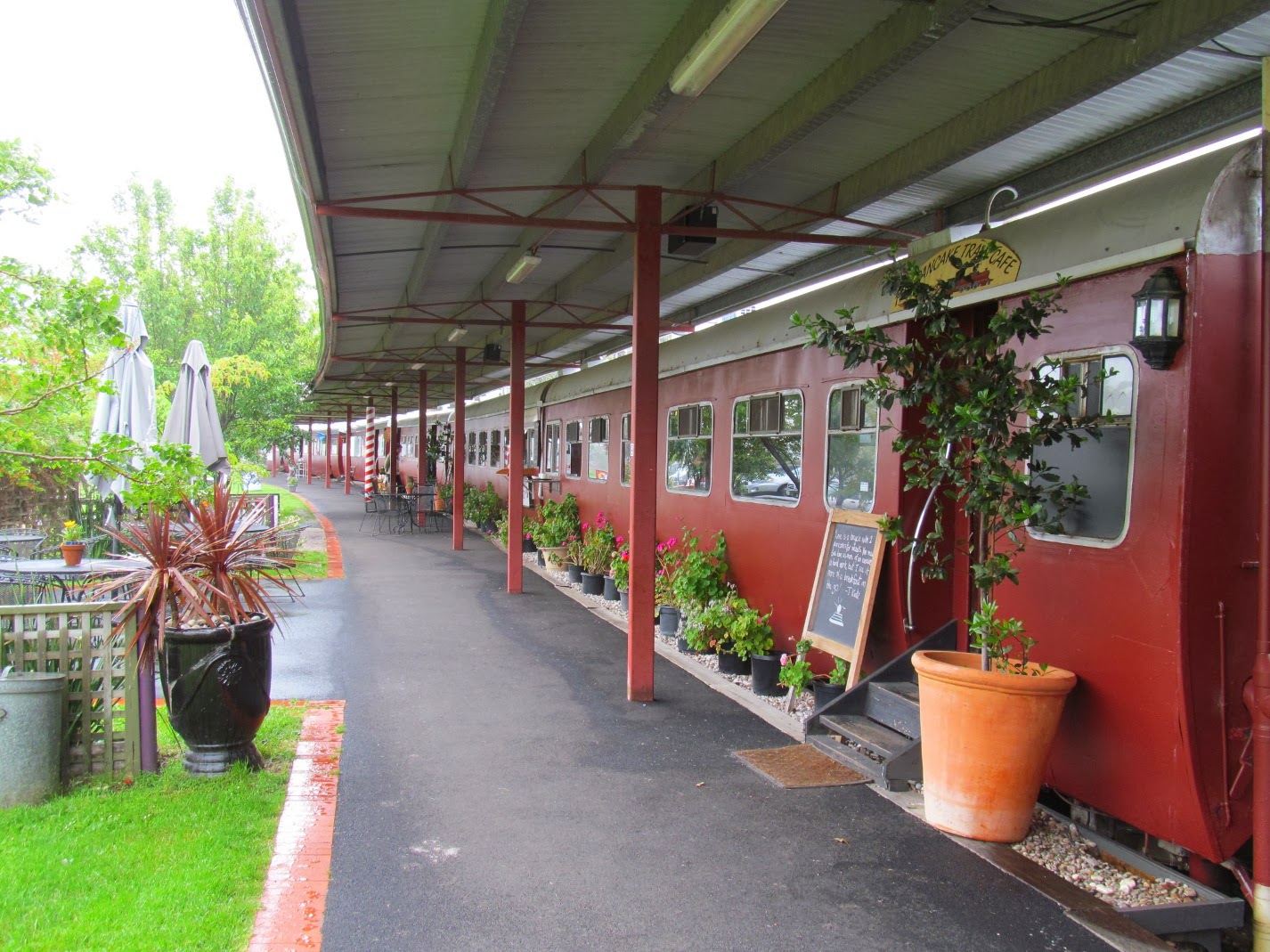
Directly next to the gardens is the Margate Train, an old decommissioned train that has been turned into a range of shops: a bookstore, a speciality food store, a barber, an antique book shop, a gift shop, and a great pancake restaurant.


On a day with much nicer weather, we visited the model village of Old Hobart Town in Richmond. This is a miniature of Hobart as it was around 1820, with lots of informative signage on history and the changes that have occurred since that time. The plan one is given and photographs on the signs allow a direct comparison of the model with Hobart as we experience it today, for example where a body of water has now been filled in etc. The small clay figures of settlers, soldiers and convicts are very amusing, with some of them shown in engaging or funny situations, for example drunk, making out on a haystack, or stepping into a paint bucket. For the plant enthusiast, all the trees in the model village are live bonsai Nothofagus (southern beeches). All in all well worth a visit.


Finally, today we explored the famous Salamanca Market in Hobart, again bracing rain. Even found a few useful things. Tomorrow it will be back to Canberra.

Wednesday, November 20, 2013

Tasmania, part 4: Western Wilderness


Western Tasmania is known for its vast expanses of untouched, impenetrable wet forest. We were also delighted by the nice mountain peaks all around us. The picture above, taken at a lookout between Derwent Bridge and Queenstown, can perhaps give a bit of an impression.


We were staying in Queenstown, which had the advantage of being nicely central with easy access to the national parks to its east and the coast to its west. Unfortunately from an aesthetic perspective, it has long been a centre of the Tasmanian mining industry. The above picture shows a part of the famed Western Wilderness of the island after open cut mining.

The information signs around town must have been sponsored by the mining industry because they oscillate between (a) outright pride at how the area around Queenstown looks now and (b) acknowledging the devastation but attempting to shame the reader into complicity. The one above this mine, for example, pointed out the following, and quite correctly it has to be admitted:
We mine the copper but you use it! You might not realise, looking out on this mining landscape, that this is all about you. Copper is still mined at Queenstown and it is a critical part of what keeps our cars, houses, computers and mobile phones working.
So hey, maybe we should buy less shiny new electronic gadgets and recycle more metal? Yes, we are collectively sawing off the branch on which we are sitting; nobody can escape their partial responsibility. Still, some of us cheer for waste and destruction but others at least try to slow the process.


Case in point: The Franklin River, focus of one of Tasmania's great politial battles of the 1980ies, when those who wanted to dam it for electricity generation clashed with those who wanted to keep this last natural river system of the island intact. Whatever you may think about it - and water power is clean energy, no doubt about that - the latter side won, and now the river brings in money as a tourist attraction.


This beautiful waterfall is Nelson Falls at the western end of the Franklin Gordon Wild Rivers National Park. Both here and at other nature walks in the area you will find several information signs on the flora and the geological history of the area. I just wish they would have consulted a knowledgable botanist when they wrote some of them...


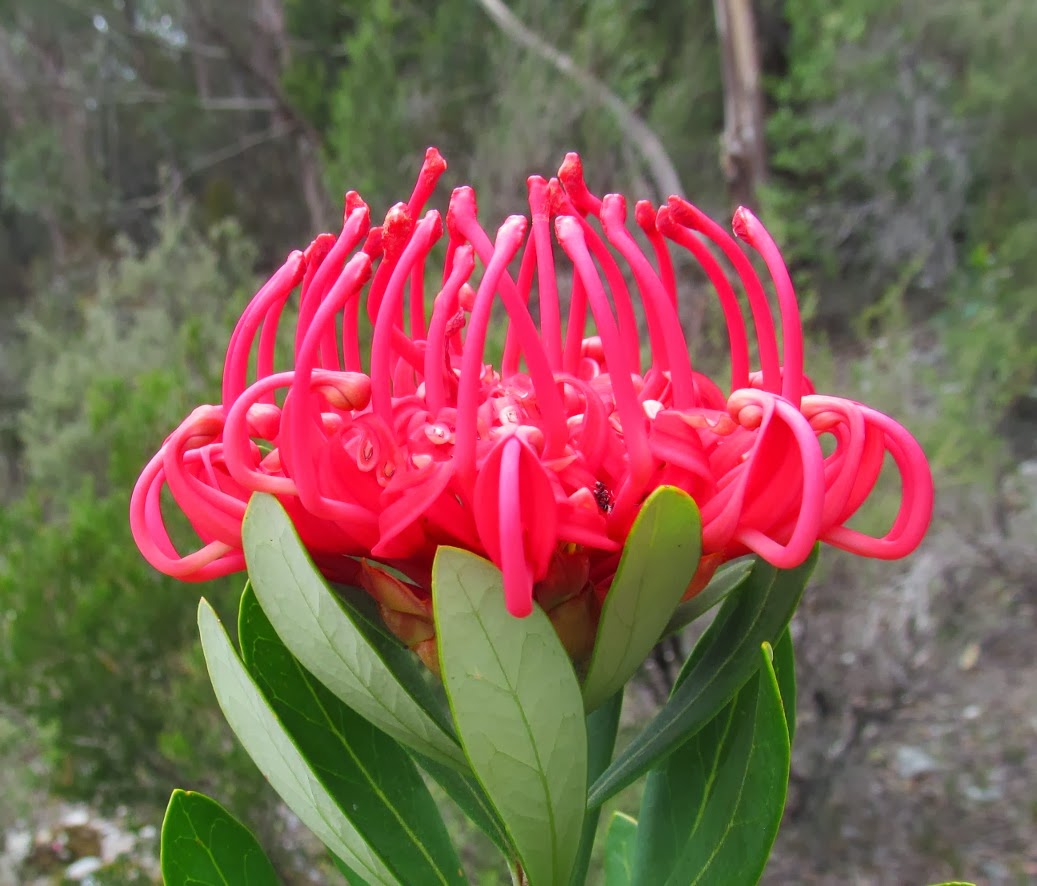
Telopea truncata (Proteaceae), the Tasmanian Waratah, at Scarlet Creek. I have now seen three of the five species of the genus, hooray!


A beautiful moss at Hogarth Falls Nature Walk. These rainforests in western Tasmania must be paradise for bryologists. Unfortunately, I do not know the name of this intricately branched species.

Sunday, November 17, 2013

Tasmania, part 3: the east coast

After the Tasman Peninsula, we went on to the east coast of Tasmania. We spent three nights at Swansea. Although the local Bark Mill Restaurant is as great as its fame would have it, and although we were happy with our accommodation, next time I would probably stay in neighboring Bicheno. The town is more scenic than Swansea, and at least at this time of the year the beach was much cleaner.


The blow hole at Bicheno. As my wife noted, all blow holes she had seen before including one on this trip at the coast of the Tasman Peninsula "worked" only when there was exceptionally stormy weather. This one appears to shoot water up all the time, even under average weather conditions. And the rocky coast around it was great too - massive boulders covered by weirdly coloured lichens, water pools, kelp forests, definitely worth a visit.


The other full day we went down to Freycinet National Park. This picture shows Wineglass Bay seen from the eponymous lookout. Beautiful but admittedly not particularly interesting botanically, at least not for me.


Another scenic spot in Freycinet, the Tourville Lighthouse.


Remember the weird grassy sculptures in the Royal Tasmanian Botanic Garden I wrote about a few days ago? Here is the real thing: a Xanthorrhoea, or grass tree, directly north of Freycinet. They often flower after fire but this one probably just thought now would be a nice time. The botanic garden where I studied in Germany had two grass trees. When they flowered once every few years that was a newspaper-worthy event, and some people would visit the garden specificaly to admire these exotic plants. And here we are and they are just another plant on the roadside...


Another thing that struck us recently was that certain areas of Tasmania were very much dominated by some species of introduced weed, and that the weed in question varies strongly from one region to the next. When we drove through the Midlands a few days ago, everything was full of some broom (we did not undertake to figure out what species). In some parts the locals tried to unroot and burn them, in others they appeared to have given up. On the east coast, on the other hand, we saw enormous stands of Centranthus ruber (Valerianaceae, shown above). And yes, ruber, that is another thing. As indicated by that name, the species is usually red-flowered but most plants here are white, as the one in the picture.

After the east coast, we made our way west, staying one night at Bronte Park Village which I remember fondly as being our base for the Skullbone Plains Bush Blitz about 18 months ago, when I first visited Tasmania. We were proudly informed that the Village would accommodate another central plateau themed Bush Blitz in the near future. Good for them!