Another big tour today. We visited the Chateau de Peyrepertuse and the Gorges de Galamus, both among the most popular tourist destinations of the area.
The chateau is one of the most spectacular Cathar fortifications, and it costs EUR 6.50 per adult to visit. This is the upper castle of Peyrepertuse as seen from the lower castle. Even getting to the lower level is already a tiresome climb; getting up there even more so.
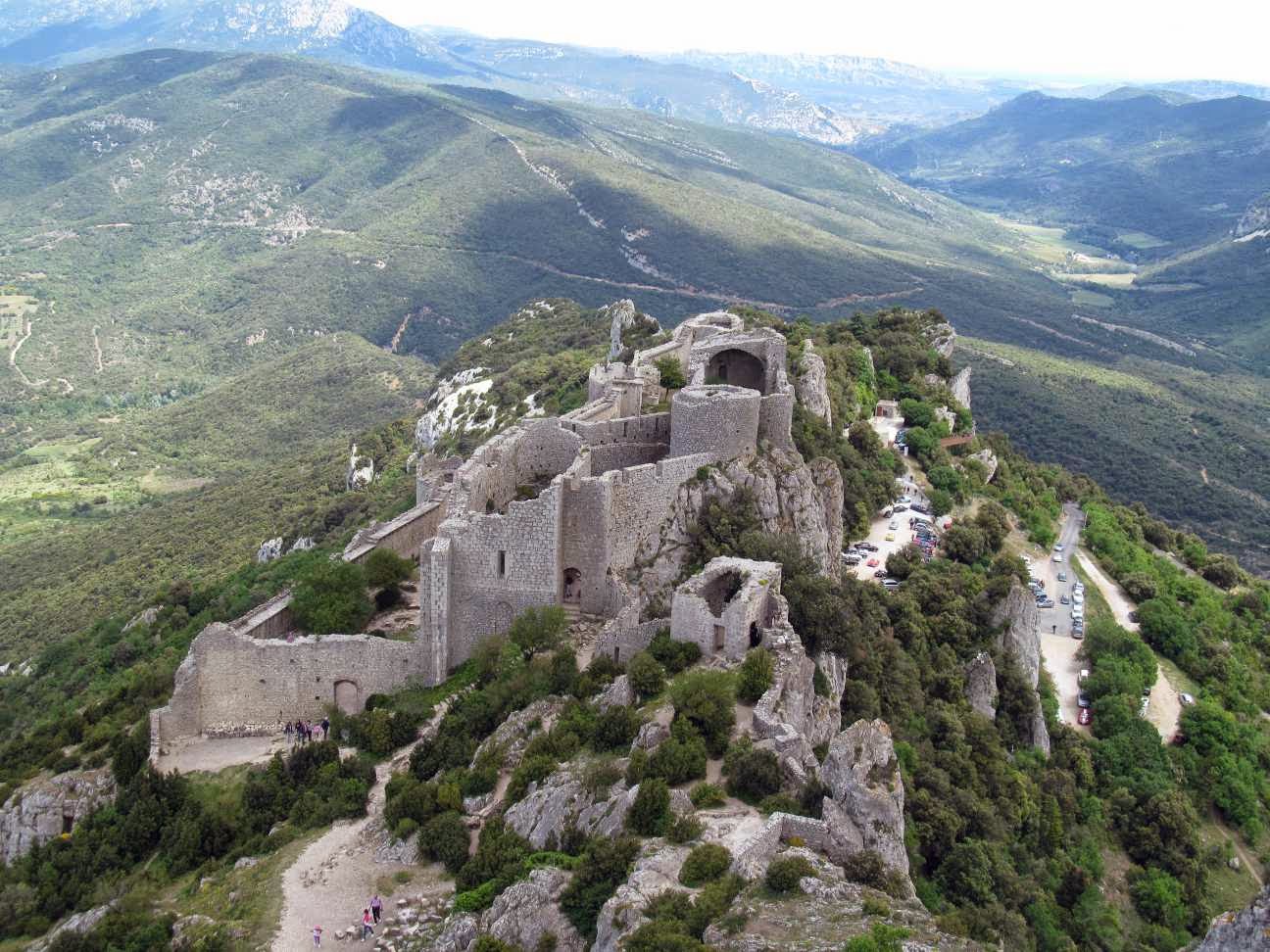
But it is so worth it - here is the view of the lower castle from the upper one. Note the many corners of the structure. The builders had to construct it into the rock, making use of whatever space they could find. I wondered in what was labelled the governor's room why there was so much rock on its floor that nobody had chiselled away, and whether the apartment had two maisonette-style levels of wooden floor when the castle was in use.
The second locality we visited were the Gorges de Galamus. If you look closely you can see the is a hermitage built onto the shoulder of the mountain in the middle of the picture. There is a path to the hermitage but we decided we did not have the time to visit it.
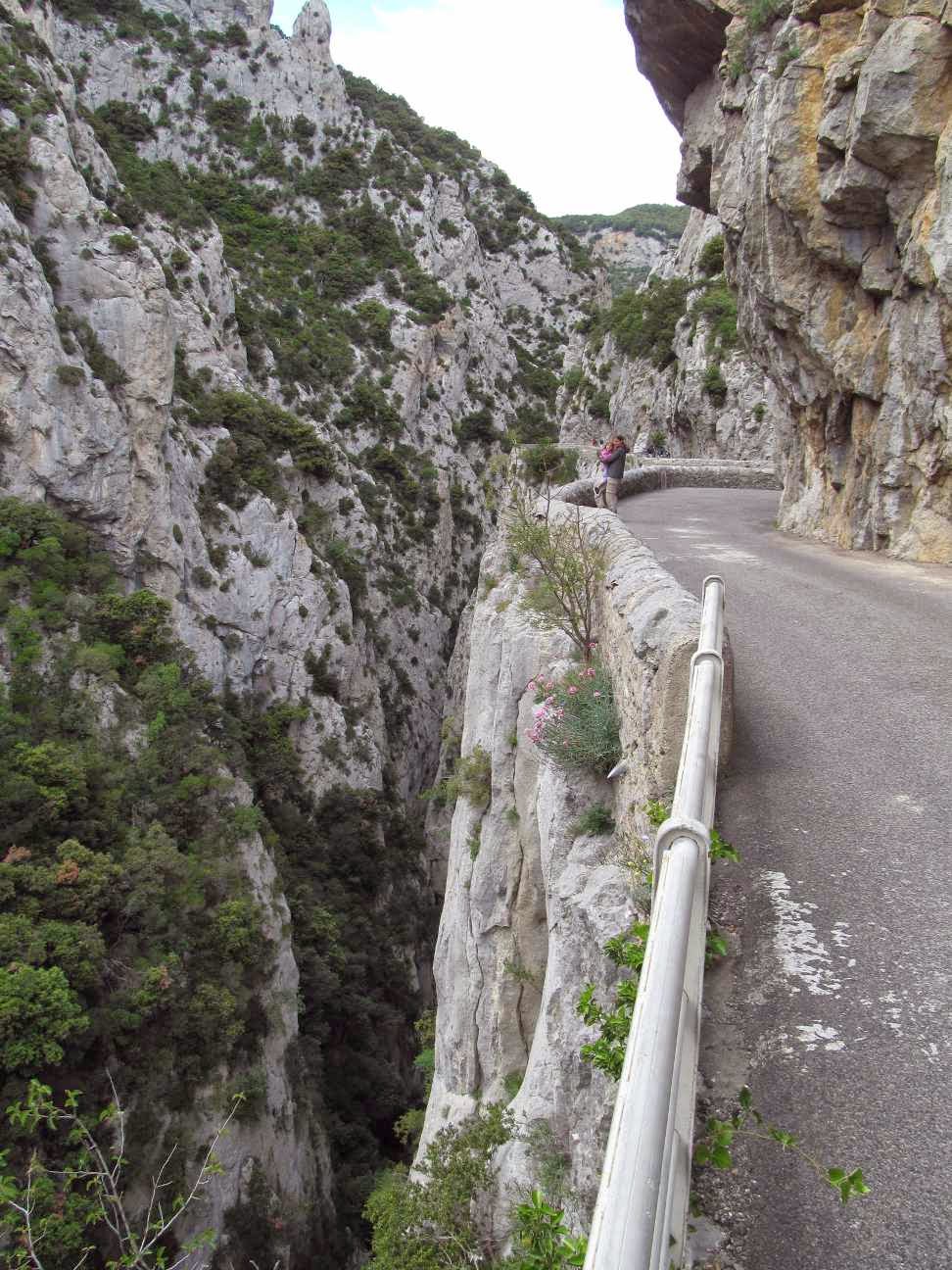
And this is the gorge itself. The tiny figures on the right are my wife and daughter, to demonstrate just how deep and steep the valley is. Unfortunately, a French society of vintage car enthusiasts decided to have their annual meeting in the area, and when we had to pass through the gorge their convoy of dozens of cars came the other way. Which is not something that the gorge can easily accommodate.
(Interesting, by the way, that the people in those vintage cars were nearly all elderly couples, in the driver's seat were always the men and never the women, and they had rather annoyingly smug expressions while driving. I am afraid that extreme car enthusiasts in general are probably not my kind of people.)
This may not be the prettiest plant I could show, but it is of the plant group I work on professionally. Phagnalon sordidum (Asteraceae), a half-shrub of rocky slopes and walls, here seen in the Gorges de Galamus.
Saturday, May 31, 2014
Wednesday, May 28, 2014
Europe day 9: Carcassonne
Another big trip today, this time to Carcassonne. I had been there before, in 1999, but did not remember that it was so big, and then probably did not visit the inside of the castle itself.
The city walls. Although this is the quintessential medieval fortified town, it appears to me that it was rarely useful. After the Roman empire collapsed, the town was conquered by the Visigoths, the Arabs and the Franks. Later, during the aforementioned Cathar crusade, it surrendered to the crusader army. Ironically, one of the rare cases where the fortifications worked was when the Cathar lord tried to retake his castle from the Crusaders a few years later...
City fortifications as seen when entering through the Narbonne gate. There were two portcullises operated from two separate rooms - bribing only one soldier wouldn't work!
This one shows a nice view from the inner castle over the fortifications down to the new city. I particularly like the tower in the centre of the photograph. According to information provided during the tour it dates back to late Roman times as can be seen from its U-shaped foundations: flat towards the town, rounded towards the outside. Also, Roman defensive towers still had larger windows than later Medieval towers.
Another historic town we stopped at is Lagrasse. It has an abbey ruin, but depicted here are a bridge and the outer houses.
On a nature walk near Lagrasse we found this Rutagraveolens angustifolia (Rutaceae) with its intricately fringed flowers. It is a close relative of the traditional aromatic plant Ruta graveolens, and although a herb it is of the same family as oranges and lemons. (Update: Le oops.)
The city walls. Although this is the quintessential medieval fortified town, it appears to me that it was rarely useful. After the Roman empire collapsed, the town was conquered by the Visigoths, the Arabs and the Franks. Later, during the aforementioned Cathar crusade, it surrendered to the crusader army. Ironically, one of the rare cases where the fortifications worked was when the Cathar lord tried to retake his castle from the Crusaders a few years later...
City fortifications as seen when entering through the Narbonne gate. There were two portcullises operated from two separate rooms - bribing only one soldier wouldn't work!
This one shows a nice view from the inner castle over the fortifications down to the new city. I particularly like the tower in the centre of the photograph. According to information provided during the tour it dates back to late Roman times as can be seen from its U-shaped foundations: flat towards the town, rounded towards the outside. Also, Roman defensive towers still had larger windows than later Medieval towers.
Another historic town we stopped at is Lagrasse. It has an abbey ruin, but depicted here are a bridge and the outer houses.
On a nature walk near Lagrasse we found this Ruta
Tuesday, May 27, 2014
Europe day 8: Various ruins
Today we made a trip to the coast to escape the rain. Along the way we went for a short walk in the Garrigue and visited two other sites.
This is the first one, the ruins of the village of Perillos which was deserted about a century ago. Recently work has begun to restore some of the houses such as the one just visible in the upper left corner of the picture, but the atmosphere was still somewhat strange.
Nearby is the ruin of the Chateau de Opoul, here seen from the car park below it. It is much less intact than the previous castle we visited.
Still, the toilet appears to be just as functional as it was hundreds of years ago. But that is probably partly because it is fairly low tech: a hole in a seat jutting out just past the castle wall.
The caste commanded a great view across the valley and towards the Mediterranean Sea. In the background the village of Opoul.
Around the castle I was glad to see Leuzea conifera (Asteraceae) starting to flower. The German name of this low-growing daisy is Zapfenkopf, or cone-head. At first sight it looks as if it might be an apomorphic segregate of Centaurea. Will have to look up if it is actually nested withing that genus.
This is the first one, the ruins of the village of Perillos which was deserted about a century ago. Recently work has begun to restore some of the houses such as the one just visible in the upper left corner of the picture, but the atmosphere was still somewhat strange.
Nearby is the ruin of the Chateau de Opoul, here seen from the car park below it. It is much less intact than the previous castle we visited.
Still, the toilet appears to be just as functional as it was hundreds of years ago. But that is probably partly because it is fairly low tech: a hole in a seat jutting out just past the castle wall.
The caste commanded a great view across the valley and towards the Mediterranean Sea. In the background the village of Opoul.
Around the castle I was glad to see Leuzea conifera (Asteraceae) starting to flower. The German name of this low-growing daisy is Zapfenkopf, or cone-head. At first sight it looks as if it might be an apomorphic segregate of Centaurea. Will have to look up if it is actually nested withing that genus.
Saturday, May 24, 2014
Europe day 4
Walked from Lanet to Mouthoumet and back today and am pretty tired now. Either just not used to it any more or still jetlagged, don't know what.
In Lanet the houses and lanes form an intricate maze. Old French villages can be very charming. Note sunbathing cat on the wall to the right.
Lanet as seen from above, from the slopes above the village towards Mouthoumet.
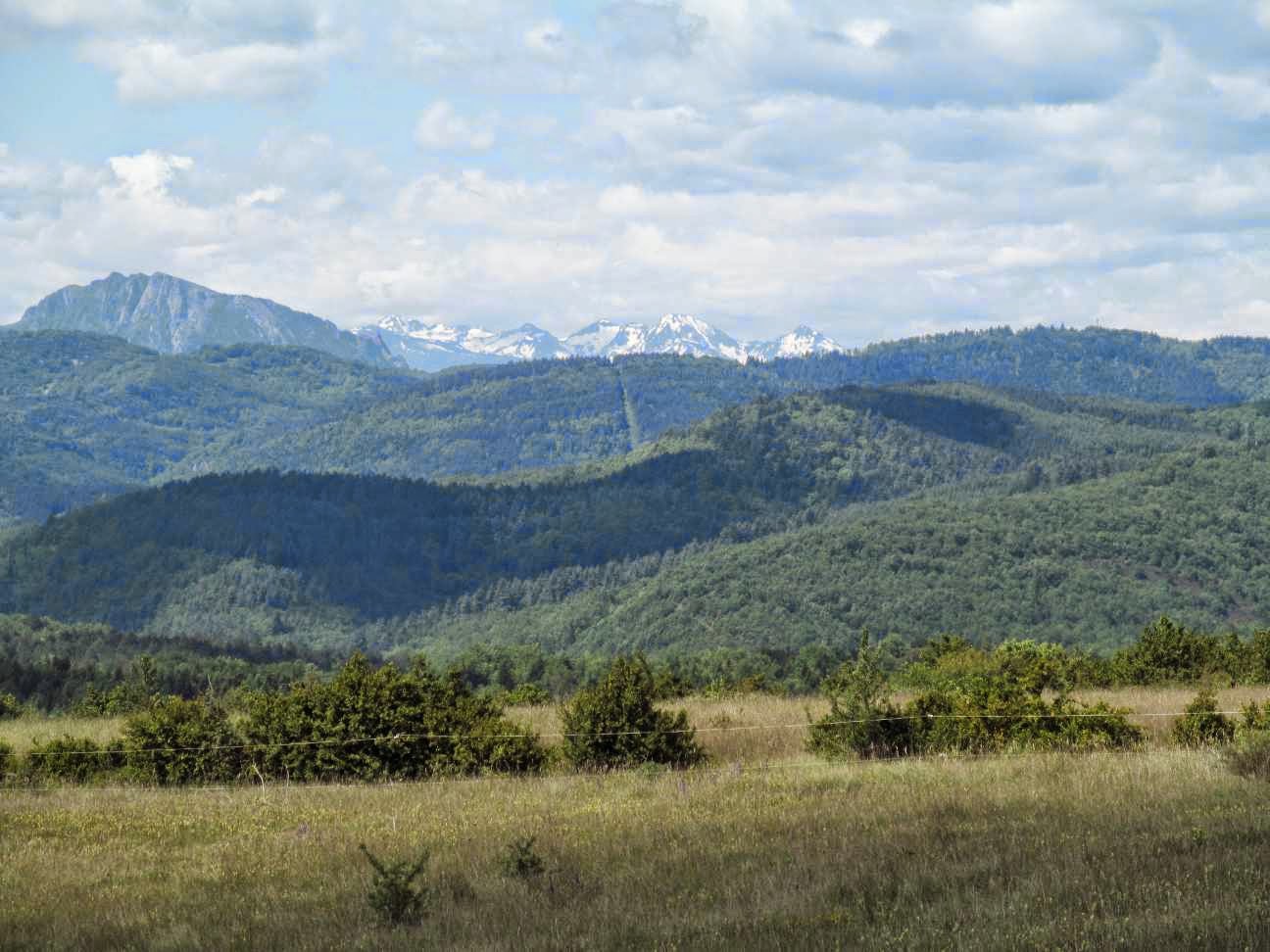
The high plain between the two villages, at approximately 500 m.a.s.l., with a view towards the snow-capped Pyrenees in the distance.
A patch of wild thyme along the way. There were, of course, many more flowers but some of them I don't know the name of yet. I will save them for future botany pictures.
My mother in law made Chevre Chaud yesterday evening. Goat's cheese wrapped in bacon and seasoned with Herbes de Provence, accompanied with seasoned tomatoes. Baked in oven at 220C for 20 min. Served with bread. Simple but delicious.
In Lanet the houses and lanes form an intricate maze. Old French villages can be very charming. Note sunbathing cat on the wall to the right.
Lanet as seen from above, from the slopes above the village towards Mouthoumet.
The high plain between the two villages, at approximately 500 m.a.s.l., with a view towards the snow-capped Pyrenees in the distance.
A patch of wild thyme along the way. There were, of course, many more flowers but some of them I don't know the name of yet. I will save them for future botany pictures.
My mother in law made Chevre Chaud yesterday evening. Goat's cheese wrapped in bacon and seasoned with Herbes de Provence, accompanied with seasoned tomatoes. Baked in oven at 220C for 20 min. Served with bread. Simple but delicious.
Friday, May 23, 2014
Europe day 3: Chateau de Puivert
Today we visited the Labyrinthe Vert near Nebias and afterwards the Chateau de Puivert. The former is an amazing area of forest with stunning rock formations but sadly characterised by perennial half-shade, making it hard to get decent pictures with my camera. The following are therefore all either plants or photographs of the castle ruin.
The Chateau de Puivert is one of the many castle ruins in the area that played a role in the Cathar wars. This one was conquered by the crusaders after three days and four nights of fighting.
It was inhabited until the French revolution and has been extensively restored in the last few decades. It was used as setting for several movies, probably partly due to the relatively good state of repair of its main towers and partly due to its accessibility.
Inside there is a small exhibit of medieval items - mostly replicas as far as I can tell. (I know very little French.) There is a suit of armor and a few helmets, instruments, official seals, and some furniture.
It is much easier to see orchids in the Corbieres than in Germany, for example. The above is perhaps one of the prettiest European orchids (or at least that is my opinion) but also a relatively common one. Orchis ustulata (Orchidaceae).
Not an orchid but also an intricately built, zygomorphic flower: Polygala (Polygalaceae). Don't know the species, unfortunately.
The Chateau de Puivert is one of the many castle ruins in the area that played a role in the Cathar wars. This one was conquered by the crusaders after three days and four nights of fighting.
It was inhabited until the French revolution and has been extensively restored in the last few decades. It was used as setting for several movies, probably partly due to the relatively good state of repair of its main towers and partly due to its accessibility.
Inside there is a small exhibit of medieval items - mostly replicas as far as I can tell. (I know very little French.) There is a suit of armor and a few helmets, instruments, official seals, and some furniture.
It is much easier to see orchids in the Corbieres than in Germany, for example. The above is perhaps one of the prettiest European orchids (or at least that is my opinion) but also a relatively common one. Orchis ustulata (Orchidaceae).
Not an orchid but also an intricately built, zygomorphic flower: Polygala (Polygalaceae). Don't know the species, unfortunately.
Thursday, May 22, 2014
Europe day 2: Cascades de l'Orbieu
Yesterday we arrived in France, and so it is unsurprising that the most dominant feature of today is jetlag. We are taking it slow. However, we made a few small walks in the vicinity.
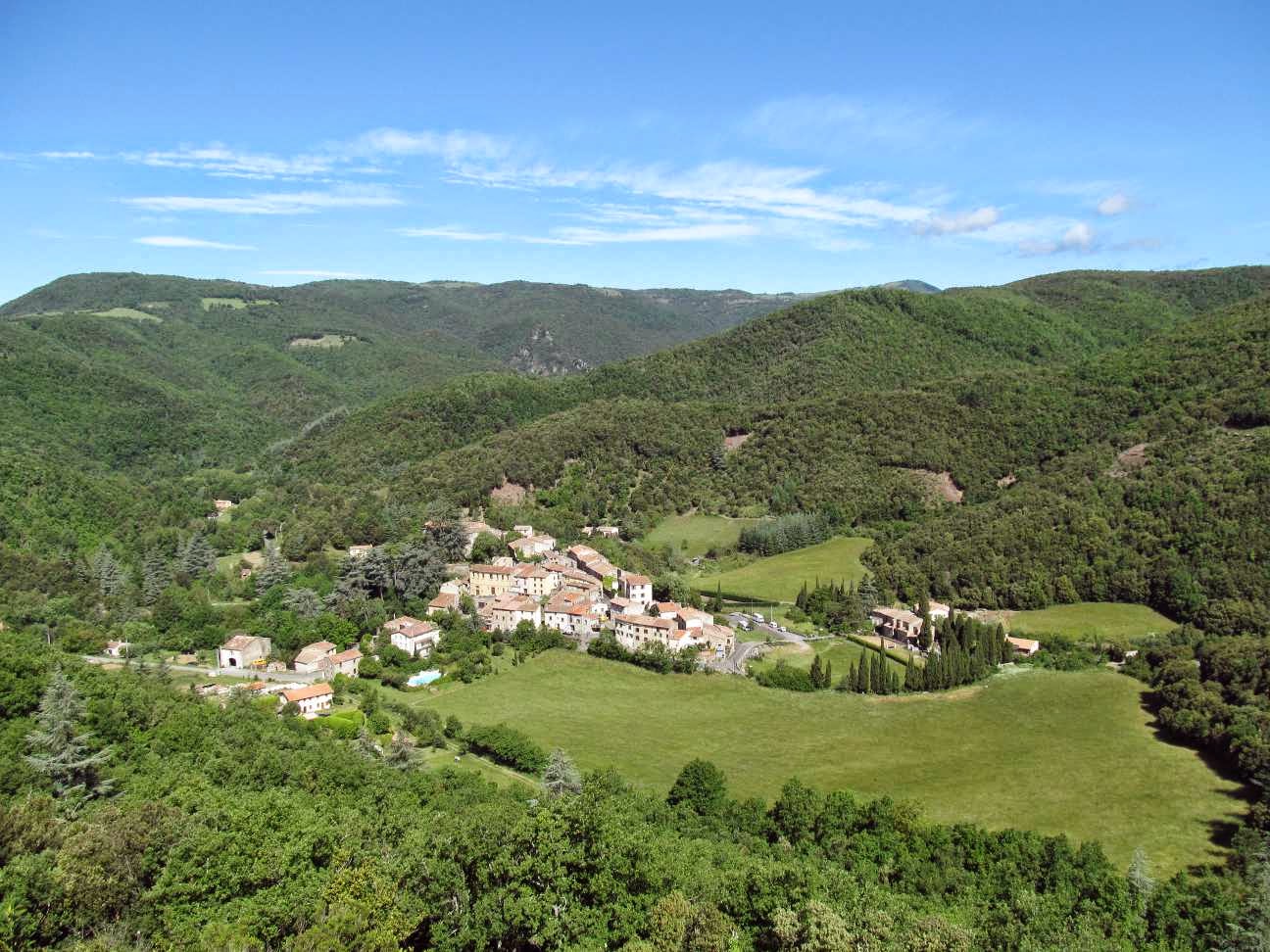
The above picture shows what we might call the Central Business District of the village we are staying in. Lanet has approximately 60 permanent inhabitants and is surrounded by a few paddocks and lots of awesome forest, mostly of Quercus ilex, Quercus pubescens, Erica arborea and Buxus sempervirens.
An applemint (Mentha suaveolens, Lamiaceae) clogging up a waterspout on a wall in the village. I wonder how the seed got there. And I wonder what happens 'upstream' if there is strong rain.
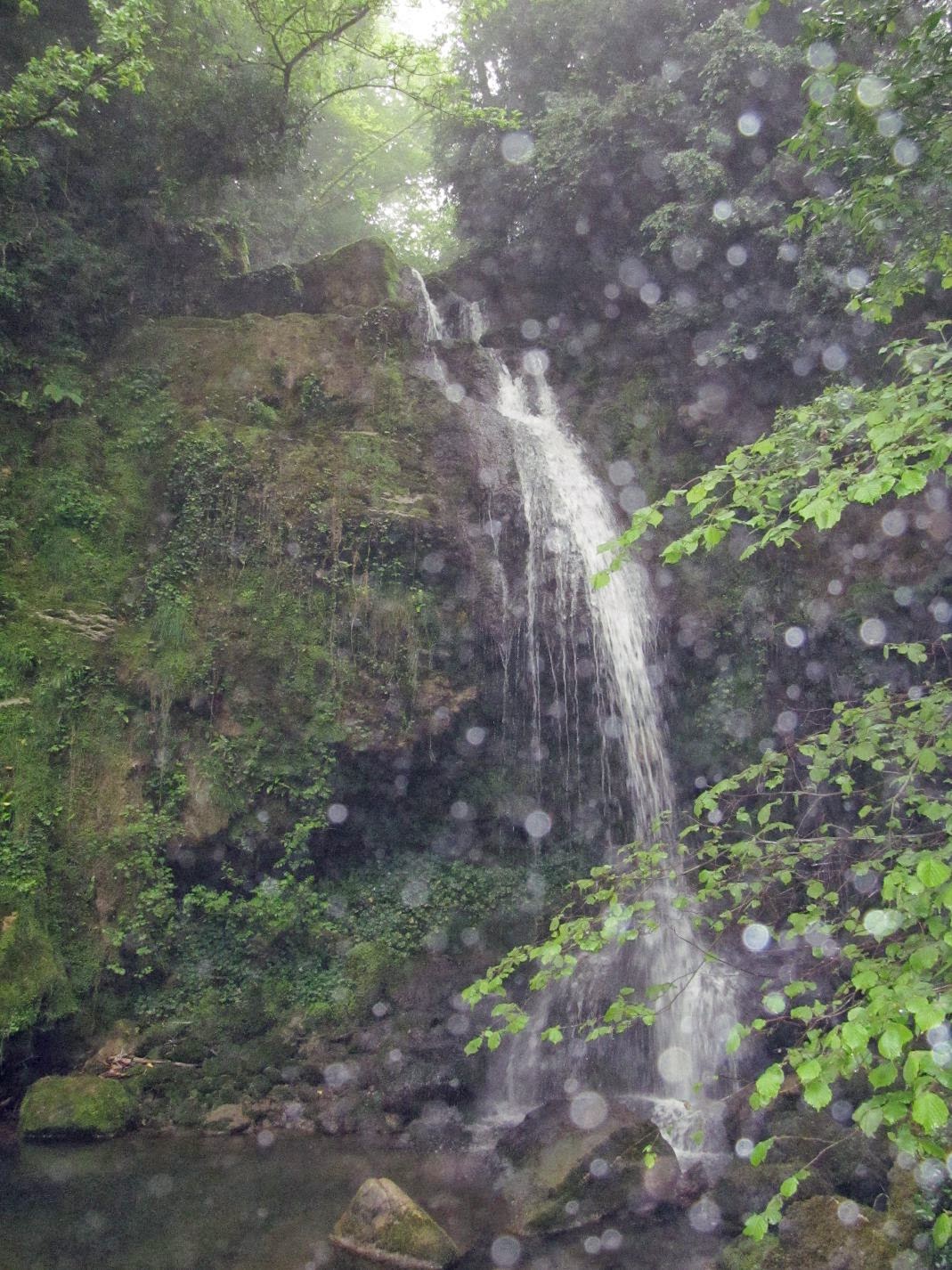
The endpoint of our last walk today, the cascades of the Orbieu near the old watermill ruins. It was very foggy, and consequently I found it very difficult to take decent pictures, but this one does capture the atmosphere.
The river below the cascades. Although the area is in the rain shadow of the Pyrennees and accordingly dry, it is perennially wet in this particular location. The vegetation is dominated by mosses and ferns, for example Phyllitis scolopendrium, Polypodium australe and Asplenium trichomanes.
Finally, and to end on a very botanical note, a 'princess' my wife made for our daughter from a poppy flower and grass.
The above picture shows what we might call the Central Business District of the village we are staying in. Lanet has approximately 60 permanent inhabitants and is surrounded by a few paddocks and lots of awesome forest, mostly of Quercus ilex, Quercus pubescens, Erica arborea and Buxus sempervirens.
An applemint (Mentha suaveolens, Lamiaceae) clogging up a waterspout on a wall in the village. I wonder how the seed got there. And I wonder what happens 'upstream' if there is strong rain.
The endpoint of our last walk today, the cascades of the Orbieu near the old watermill ruins. It was very foggy, and consequently I found it very difficult to take decent pictures, but this one does capture the atmosphere.
The river below the cascades. Although the area is in the rain shadow of the Pyrennees and accordingly dry, it is perennially wet in this particular location. The vegetation is dominated by mosses and ferns, for example Phyllitis scolopendrium, Polypodium australe and Asplenium trichomanes.
Finally, and to end on a very botanical note, a 'princess' my wife made for our daughter from a poppy flower and grass.
Saturday, May 17, 2014
Public service announcement
The next four weeks I will be travelling in Europe, so updates will become sporadic. On the other hand, when I update I will have nice pictures of plants and landscapes. It is spring there, after all.
Subscribe to:
Posts (Atom)