We are making use of school holidays to go on a little trip to Australia's New England area, i.e. the north-east of New South Wales. This is the first time we visit it. We have been making our way there slowly over Saturday and Sunday, and on Sunday evening we were generously welcomed to Armidale by botany professor Jeremy Bruhl, his family, and fellow botanist Ian Telford. We will explore waterfalls, forests and lookouts of the New England high country over the next few days.
The above is the view from Moonbi Lookout back towards Tamworth, the last really large town we passed through before reaching Armidale (it is too far away to be visible though).
Today I dropped into the N.C.W. Beadle Herbarium of the University of New England, of which herbarium Jeremy Bruhl is the director. Read more about this scientific collection, its importance and history on its website.
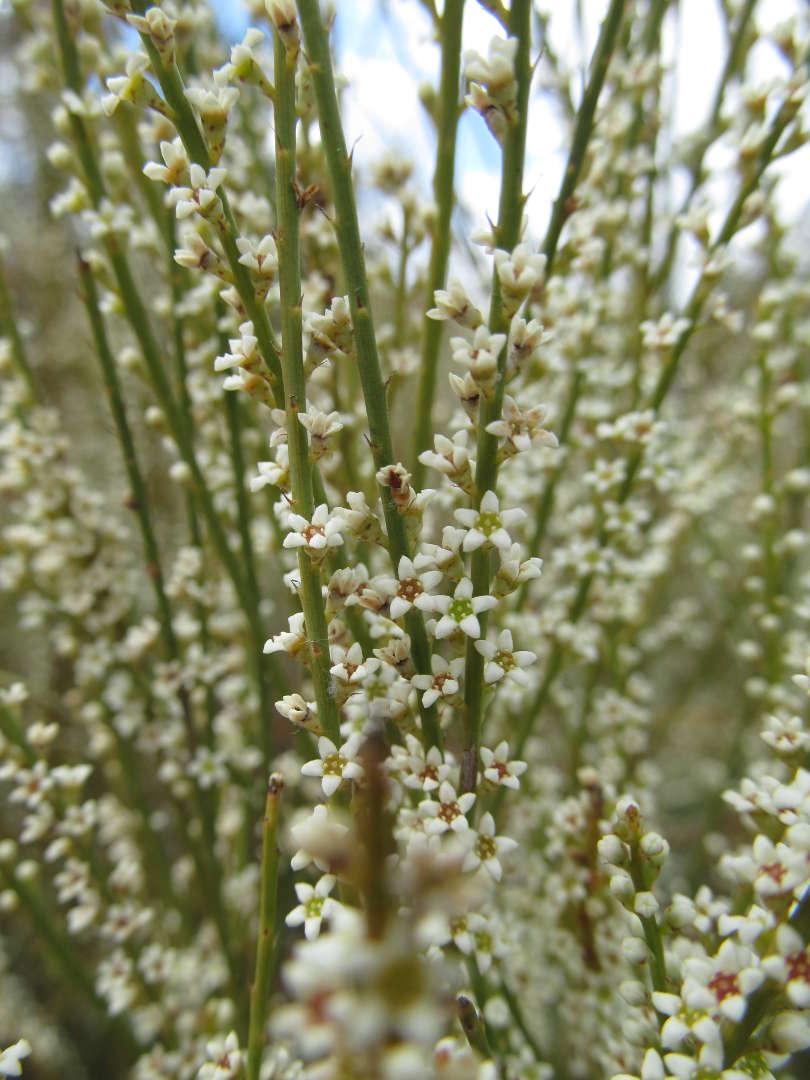
An impressively floriferous and sweetly smelling shrub we saw on the way near Premer is this Santalaceae. I am reasonably sure it is Choretrum candollei.
Monday, September 28, 2015
Wednesday, September 23, 2015
The Templeton Test in parsimony analysis: part 2, how to do it in PAUP and TNT
After discussing the Templeton Test in an earlier post, this post is about how to conduct it in practice.
Monday, September 21, 2015
Floriade 2015
Impressions from our visit to the Floriade spring festival yesterday.
Tulip mania! Interestingly, the red ones were still behind the white and yellow ones, meaning that the plantings will only really come into their own in a week or so.
With the first World War a hundred years ago, Australia has had war related events since last year and is set to continue until 2018. As a German I find it fascinating to see the difference in perspective, as in Europe the horrors of WW2 have totally overshadowed anything that happened in the first, which is also much further back in the past. But Australia lost such a large number of young men that WW1 left a more lasting impression than it did in much of Europe.
Anyway, poppies are apparently associated with remembrance of war. Here people could pay a bit of money for a poppy to place on the wall, and the proceeds went to a charity.
The view from above - this is the first time I was on the Floriade's Ferris Wheel.
Tulip mania! Interestingly, the red ones were still behind the white and yellow ones, meaning that the plantings will only really come into their own in a week or so.
With the first World War a hundred years ago, Australia has had war related events since last year and is set to continue until 2018. As a German I find it fascinating to see the difference in perspective, as in Europe the horrors of WW2 have totally overshadowed anything that happened in the first, which is also much further back in the past. But Australia lost such a large number of young men that WW1 left a more lasting impression than it did in much of Europe.
Anyway, poppies are apparently associated with remembrance of war. Here people could pay a bit of money for a poppy to place on the wall, and the proceeds went to a charity.
The view from above - this is the first time I was on the Floriade's Ferris Wheel.
Saturday, September 19, 2015
Lifeline Book Fair
Great haul at the LifeLine Book Fair this spring, it was a good idea to go early on Saturday this time.
Thursday, September 17, 2015
The Templeton Test in parsimony analysis: part 1, principles
When we want to know whether a taxon, for example a genus, is monophyletic (and thus acceptable in a phylogenetic classification), the first thing to do is to infer a phylogeny. We may then find a topology like the following:
Genus A is non-monophyletic on this tree because B is sister to A2. However, the support value for clade A2 + B (the red number, 63 of 100) is not exactly stunning; if this is Bayesian Posterior Probability, you would want 95 or higher, and if it is bootstrap or jackknife you would still want to see at least 80 or so, preferably more. With so little support it could just as well be that these relationships are wrong and genus A is monophyletic after all.
(It is amazing, by the way, how many people find it hard to intuit that when discussing the status of A the red support value is indeed the relevant one. If it is high then precisely that number provides support for the non-monophyly of A while the black value is irrelevant - it merely shows that A1, A2 and B belong together but doesn't tell us anything about A versus B. Some time ago I even had a peer reviewer who got that wrong at first. Perhaps people are just so trained to look for how strong the evidence for monophyly is that they can get confused when they need to look for evidence for non-monophyly.)
So yes, the tree shows A as non-monophyletic, but we can't be sure if the evidence is strong enough. Is there another way of testing whether, let us say, A is "significantly" non-monophyletic?
This is where, for parsimony analysis, the Templeton Test comes in, which by the way doesn't have anything to do with the Templeton Foundation.
Genus A is non-monophyletic on this tree because B is sister to A2. However, the support value for clade A2 + B (the red number, 63 of 100) is not exactly stunning; if this is Bayesian Posterior Probability, you would want 95 or higher, and if it is bootstrap or jackknife you would still want to see at least 80 or so, preferably more. With so little support it could just as well be that these relationships are wrong and genus A is monophyletic after all.
(It is amazing, by the way, how many people find it hard to intuit that when discussing the status of A the red support value is indeed the relevant one. If it is high then precisely that number provides support for the non-monophyly of A while the black value is irrelevant - it merely shows that A1, A2 and B belong together but doesn't tell us anything about A versus B. Some time ago I even had a peer reviewer who got that wrong at first. Perhaps people are just so trained to look for how strong the evidence for monophyly is that they can get confused when they need to look for evidence for non-monophyly.)
So yes, the tree shows A as non-monophyletic, but we can't be sure if the evidence is strong enough. Is there another way of testing whether, let us say, A is "significantly" non-monophyletic?
This is where, for parsimony analysis, the Templeton Test comes in, which by the way doesn't have anything to do with the Templeton Foundation.
Tuesday, September 15, 2015
Botany picture #214: Grevillea arenaria
Grevillea arenaria (Proteaceae) is described in the online flora of New South Wales as "red, pink or orange, often green or yellow at base", but if the label on this specimen in the Australian National Botanic Gardens is correct then it is surely quite on the green side. Perhaps a variant? Certainly the most unusual flower colour I have seen in this genus so far.
Sunday, September 13, 2015
Isaac Asimov's Foundation
I spent much of the week at a meeting in Tasmania. On the last day I had time to browse a book store and finally bought the first Foundation novel after I had only found sequels and prequels at the local book fair so far.
It is not so much a novel as a compendium of several shorter stories, each with their own characters and representing several stages of the development of the eponymous Foundation. I have written before about some of the other books in the series (Foundation and Empire, Foundation's Edge). Although my observations on this book are similar to those on the later ones, somehow it doesn't feel quite as blatant.
Subscribe to:
Posts (Atom)