Monday, July 31, 2017

IBC and Shenzhen impressions

Seen at my hotel.

Shenzhen Convention and Exhibition Centre.

Exhibition area, with poster area in upper right corner of picture.

One of the larger lecture halls.

After dark.

Poster area.

Tea break in the hall between the smaller lecture rooms.

Wednesday, July 26, 2017

International Botanical Congress 2017, Shenzhen

A few thoughts after the first two full conference days of the IBC 2017. (Sunday was only the opening and a few public events, and today Wednesday is a bit of a break without symposia).

Shenzhen has really pulled out all the stops to host the conference. It is huge, it has a huge presence in the city, and everything is well organised. The city itself is also a good location. I am not personally a fan of skyscrapers, but of course only a large city like this has the infrastructure for a congress of more than 6,000 delegates. The subway system in particular is amazing.

What I am less convinced of at the moment is the way the scientific program has been organised. In what is apparently custom for IBCs, all the symposia were set in advance, and for each symposium the organisers were required to arrange four set talks and fill the remaining two slots competitively from non-invited submissions.

I find that unfortunate. Why not set perhaps half the symposia, call for free submissions, and then group all the latter thematically into additional symposia? If you get twelve talk submissions for palaeobotany, for example, simply arrange for one of the more accomplished speakers to chair the whole thing. I have not yet heard an argument against such an approach beyond "but that means that they would have less time to organise the symposia", but other meetings do not seem to have any problems with it, from what I hear even very large ones.

I have also heard from many others, and observe myself, that there are too many parallel symposia, and often symposia that would clearly attract the same clientèle are placed in parallel to each other. One of the reasons this happens to such a high degree is that only a small part of the day - four hours in the afternoon and, again, even excluding today - is reserved for the general symposia, while the entire morning is given to keynotes and plenaries.

Now I may be in the minority here, but I am not to be counted among those who primarily go to a conference to hear a famous person give a keynote lecture. At their best they are the oral presentation equivalent of review papers, but I see the benefit of meetings mostly in networking and learning about new results and methods, the oral presentation equivalent of research papers. And for this the general symposia are the places to be. I am consequently wondering if it would not be more productive to increase current symposium time slots by 50% and to cut the number of keynotes and plenaries in half. This would also mean that less symposia would have to run in parallel.

Overall I have seen some very amazing talks, but also some that appeared a bit uninspiring and could have benefited from a more explicit explanation of what the research question even was and why the audience should care. I have heard of software that I should look into and learned about tools that have become more powerful since I last tried them, but also groaned about "paraphyletic individuals" and the assumption that the traits of the smaller of two clades automatically represent the ancestral states. And of course I have met colleagues from overseas who in many cases I haven't seen since the last IBC in 2011.

Now I just have got to get my own talk down from a rambling 25 min to 15-20 and all will be good...

Saturday, July 22, 2017

The Prince

I have arrived in Shenzhen, China, for the International Botanic Congress. I meant to upload a few pictures of the Luohu district today but it seems as if my cell phone does not want to talk to my laptop, so perhaps I can do that when I am back.

On the flights I was unable to get much work done beyond making corrections to a manuscript, so I read a book and watched movies of varying quality: Star Wars Rogue One, Suicide Squad, and Throne of Elves. It is all a matter of expectations; they weren't high, so I enjoyed all three, although the last of them partly for being so different from how a European would have done it, and while happily ignoring the humongous plot holes of the second. The funny thing about Rogue One is that it is actually in part a reasonably good attempt at rationalising why the heck the Empire would have built the Death Star with such an idiotic weakness, although it still remains implausible that nobody else noticed it during construction and just added another wall on the way.

Ah well. Anyway, the book I read nearly through on the flights - because it is not actually all that long - is Machiavelli's Il Principe. The book needs no introduction as it is a classic, but I had never read it until I happened to pick it up in a German retranslation at the last book fair I visited.

The scholar who wrote the foreword stresses that Machiavelli's reputation is undeservedly bad, that his work is really a groundbreaking piece of political philosophy. With Il Prinicipe and its sister work on republics he is considered to have pioneered political writing that sees humans as capable of influencing history within certain realistic limitations instead of being the passive objects of divine providence, and that argues for a pragmatic approach to politics instead of an unachievable spiritual ideal or political utopia.

And yes, I can see where that is coming from, although given my political socialisation I always remain sceptical of seeing history as a chain of outstanding people having influential ideas. (I think it is much more likely that if Machiavelli had not written this book others would still have organically moved towards more pragmatic political philosophy, as that was simply the Zeitgeist.)

But I can also see clearly where his bad reputation comes from. Not only is he fairly open about criticising past politicians and military leaders, including popes, for their personal and public failures, which would obviously invite opprobrium. He also matter-of-factly advises the audience to betray their allies for political gain and to murder the entire family of a previous ruler so that their bloodline is extinguished and no remaining heir can challenge the new order.

Again, both Machiavelli and the author of the foreword argue that this is just realistic. If you want to secure power and strengthen your state then this is what you must do. Machiavelli also doesn't see any issues with such behaviour because he has a very dim view of humanity in general. For example, to him it is no problem to break treaties because your treaty partners are, well, humans and as such should be expected to break the treaty themselves at the first good opportunity. That's just how dastardly humans are, fide Machiavelli at least.

Now realism is one thing. I can understand Machiavelli's advice in many cases, for example when he considers whether it is more important and easier to have the general population on one's side or the nobility (in today's context, the one percenters), and how to achieve either. And I also understand that one has to be realistic about the established rules one is subject to; if everybody habitually lies then a single honest person will indeed perish where another liar may have prospered. But I think he and that modern scholar miss to what a large degree opportunistic breaking of rules changes the rules for the worse, and what the consequences are.

Be it keeping true to treaties or showing mercy to one's enemies, the point of following rules or gentlemen's agreements is that only then can you expect that others will follow them to your benefit. When, for example, it became customary in the early to high middle ages of Germany that nobles competing for the crown would not eradicate the opposing family but instead force the male members to retire into monasteries, and only kill them if they blew that chance by coming back and raising another army, the idea was presumably that once the shoe is on the other foot one would also be given the chance to leave politics instead of coming home to find one's wife and underage children face down in puddles of blood, as Machiavelli would have it.

In other words, I am coming away from Il Principe with the impression that he was too clever by half. He took pragmatism just far enough to come out on the other side and fall back into short-sightedness.

Wednesday, July 19, 2017

How to use the reference manager Zotero

(Updated 19 July 2017 regarding Zotero 5.)

Inspired by an eMail exchange with a colleague I thought I would write a longer post on how to use the open source reference manager Zotero. Obviously all the information will in some form be available in its documentation, but at least to me the things I really need to look up are often the needle in the haystack of the obvious and the irrelevant. So here is what I think is what one needs to know to start using Zotero in what is hopefully a logical order.

All of this is based on Zotero 4, as I have not yet used the newest, version 5. From version 5 the standalone program is required instead of Zotero running through the browser alone. See the relevant comment under installation below.

How it works

Zotero is available for Win, Mac and Linux and for LibreOffice or MS Word. It integrates into the browser (I use Firefox, but it also seems to work with Chrome, Safari and Opera), and the usual way to use it is through the browser. This means that the browser has to be open at the same time as the word processor, but there is also a standalone version that I am not familiar with.

Installation

To be honest, this is the only point on which I am a bit confused at the moment because it has been a bit since I installed one of my instances. There are three items that may have to be installed: Zotero itself on the download page, for which there are specific instructions. Then there is the "connector" for the browser you have. Finally, it may be necessary to install a word processor plug-in for your browser. What confuses me is that I seem to remember only installing the latter two last time, so either I misremember or something has changed with the newest Zotero version (?).

Either way, while the installation of Zotero into the browser itself is easy, I have noticed that sometimes the word processor plug-in does not take on the first attempt. In that case I merely repeated the installation and restarted everything, and then it worked.

Update: The colleague who has now started using Zotero has, of course, installed the newest version and kindly adds the following:
The new version of Zotero needs the standalone program installed. This is because Mozilla has dropped the engine that supported a lot of extensions (like Zotero). It was deemed that allowing the browser to carry out low-level functions on the host computer introduced inherent vulnerabilities, and so Firefox versions after 48 have very much restricted what the browser is allowed to do (no longer can it communicate directly with databases, and carry out a lot of file handling functions). The problem is not restricted to Zotero, for example Gnome desktop extensions used this functionality and have also had to change the way they do things. The long and the short is that nowadays you need the standalone application installed.

Using Zotero in the browser and building your reference library

When you have Zotero installed there are two new buttons in the browser: a "Z" that opens your reference library and a symbol right next to it that you can click to import a journal article into that library. Given that the library will at first be empty let's look at that latter function first.

The Zotero buttons in the browser
For example, I may have found a journal article through a Google Scholar search. Ideally, I am now looking at the abstract or HTML fulltext on the journal website, because that page will have all the metadata I want. I now click on the paper symbol to the right of the Z, and Zotero automatically grabs all the fields it can find and saves a new entry into my reference library; if it can get a PDF it will even download that.
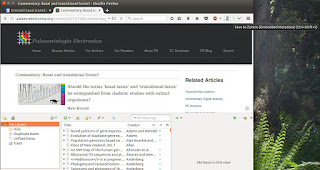
Viewing paper abstract
Now I click on the Z button to bring up my library, if I didn't have it open yet. In some cases I may notice that something went wrong. The typical scenarios are that the title of the paper is in Title Case or ALL CAPS. This is easily rectified by right-clicking on the title field and selecting "sentence case".

A reference has been added to the library
If something needs to be edited manually we can do so by left-clicking onto the relevant field. For paper titles, the usual problems would be having to re-capitalise names after correcting for Title Case or adding the HTML tags for italics round organism names. In the present case, however, I find that the title contains HTML codes for single quotation marks instead of the actual quotation mark characters, so I quickly correct that. Manual entry is, of course, also possible for an entire reference, for example if it isn't available online. In that case simply click on the plus in the green circle and select the appropriate publication type.

So much for importing references. It is also possible to bulk-import from the Google Scholar search results, but I would not recommend that as Google sometimes mixes up the metadata.

The style repository

The first time we try to add a reference to a manuscript, we are asked what reference style should be used. Zotero comes with only a few standard styles installed, but many more are available at the Zotero style repository. One of the in my eyes few downsides of Zotero is that it has less styles than Endnote, but often it is possible to get the relevant one under a different name. If, for example, you are preparing a manuscript for PhytoTaxa the ZooTaxa style should serve just as well.

Installing a new style is as easy as finding it in the style repository, clicking on its name, and confirming that it should be installed.
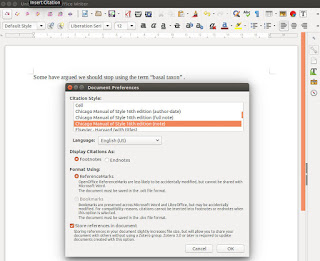
Selecting a reference style
Using Zotero in the word processor

Again, note that the browser needs to be running while we are adding references to a paper. The following assumes LibreOffice, but except for where to find the buttons everything is the same in MS Word.

In LibreOffice you will have new buttons for inserting and editing references, for inserting the reference list, and for changing document settings, in particular the reference style. To insert a reference, click on the button that seems to read r."Z. You can now enter an author name or even just a word from the title, as in my example here, and Zotero will suggest anything that fits.
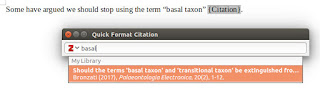
Adding a reference to a manuscript
Another downside of Zotero, at least as of version 4 which I am still using, is that it doesn't do a reference like "Bronzati (2017)". Instead you can either have "(Bronzati 2017)" or reduce the reference to "(2017)". For this click on the reference in the field where you were asked to select it (if you have already entered it simply use the edit reference button showing r." and pencil) and select "suppress author". Then you have to type the author name(s) yourself outside of the brackets, which is obviously a bit annoying.

Author names outside of brackets have to be added manually
Once we have added a few references, we obviously need to add the reference list. This is as easy as clicking the third button in the Zotero field. The only others that are usually important are the two arrows (refresh) to update the reference list (although it does so automatically when the document is reloaded) and the cogwheel (document preferences) that allows changing the reference style across the document.

In LibreOffice I have sometimes found that adding or updating references changes the format of the entire paragraph they are embedded in. This seems to happen if the default text style is at variance with the text format actually used in the manuscript. Selecting a piece of manuscript text and setting the default style to fit its format has always rectified the situation for me.

Syncing

It is useful to get an account at the Zotero website and use it to sync one's reference library across computers. Again, this works cross-platform. I do it between a Windows computer at work and my personal Linux computer at home. Note, however, that it only syncs the metadata, not any fulltext PDFs that have been saved.

To sync, go into the browser and click on the Z symbol to open Zotero. Now click the cogwheel and select preferences. The preferences window has a sync tab where you can enter your username and password. Do the same on two computers and they should share their reference libraries.

Sunday, July 16, 2017

Free-association word salad is not the same as analysis

I find it remarkable what kinds of pieces are sometimes published by otherwise serious news organisations. Today during breakfast I made the mistake of trying to read something hilariously filed under "analysis" at the ABC website, Are we sleepwalking to World War III?

It starts with the claim that WW3 is coming and that Australia will be invaded:
All certainty will be lost, our economy will be devastated, our land seized, our system of government upended.
It is backed up by what a single former military commander said to the author over lunch:
This isn't mere idle speculation or the rantings of a doomsday cult, this is the warning from a man who has made it his life's work to prepare for just this scenario.
I may be missing something here, but unless there is a bit more at least circumstantial evidence I would still file this warning as mere speculation; that is kind of what the word means.

Then the author randomly quotes out of context Mark Twain ("History doesn't repeat but it does rhyme"), Alexis de Tocqueville as writing that the French Revolution was inevitable, a claim that can very conveniently be made about any historical event after the fact because it is always untestable, and then quickly moves to a historian's work on the beginning of World War I (while spelling the name of that source in two different ways).

In this latter case at least an actual argument can be discerned: Britain and Germany were trade partners and still went to war, so we should not assume that two countries today would stay at peace just because they are trade partners.

The author accelerates his already breathtaking pace to name-check a Harvard scholar and, before that person gets to say anything useful, the Ancient historian Thucydides. He seems to imply that the USA might be forced into starting WW3 to stop the rise of China, as Sparta was forced to start the Peloponnese War when Athens became too powerful. (I read Thucydides years ago, and I seem to remember it was a bit more complicated than that.)

The text descends into gibberish for a bit:
Any clash between the US and China is potentially catastrophic, but as much as we may try to wish it away, right now military strategists in Beijing and Washington are preparing for just an eventuality.
Perhaps: "just such an eventuality"?
Global think tank the Rand Corporation prepared a report in 2015 for the American military, its title could not have been more direct -- War with China: Thinking Through the Unthinkable.
Yeah, that's the job of strategists and (serious) think tanks.
It concluded that China would suffer greater casualties than the US if war was to break out now. However, it cautioned, that as China's military muscle increased so would the prospect of a prolonged destructive war.
How... what... huh? If I picked a fight with my neighbor now, I could be hurt, BUT (!) if I picked the fight an hour later, the fight could take longer. That doesn't even begin to make sense as a sentence. Even if we try to speculate about what the author may have meant here, for example that China would lose a war now but may have a better chance of winning a few decades in the future, one would have to point out that suffering greater casualties may not be incompatible with winning now either, cf. USSR in WW2. Also, why interrupt the sentence with a comma after the main verb? Did nobody proof-read this?

Having established to his satisfaction that war could happen, the author now moves to the question what precise incident could precipitate WW3 in Asia. Again a historian is cited, and again only so superficially that it is impossible for the reader to judge if what they say can be backed up. The islands of the South China Sea and other islands disputed between China and Japan are mentioned as the most likely causes of war. Okay, so I am not a military strategist, and I appreciate how useful symbolic conflicts can be to fire up nationalism when a government is in domestic trouble, but are these really the kinds of issues where a government would say, hey, let's needlessly blow up our entire economy and get hundreds of thousands killed over a practically worthless heap of rock? (Or sand, as the case may be.)

But of course we have to move on immediately. Cyber warfare! Thucydides! (Again.) Name-checking a Chinese scholar who does think that China and the USA are too economically interdependent to go to war, so at least we have an isolated counterpoint. Then the former military commander from the beginning opines that it would be helpful if politicians would also consider the risks of going to war; I am sure nobody in the history of humanity has ever had that idea before.

The piece ends with the author claiming to be more optimistic than his interview partner, only to end on a very depressing note. He takes this as an opportunity to quote Shakespeare, I presume in case the mention of Twain, de Tocqueville and Thucydides wasn't enough to signal deep erudition.

Now don't get me wrong, I am also rather pessimistic about the future. Overpopulation, resource limits and climate change may well combine to throw the world into a new dark age, with starvation, mass migrations, widespread collapse of most institutional order, and warlords duking it out with the few Byzantine Empire-like islands of stability that are left.

But that is how I would expect a serious analysis of future trends to look like: citing empirical evidence of risk factors like crop failures, water availability or shifting alliances and how they can produce unsolvable dilemmas for all involved. Merely name-checking historians in a meandering, stream-of-consciousness text without any real information or data isn't it.

Thursday, July 13, 2017

Botany picture #248: Gleichenia dicarpa


This is one of my favourite fern photographs: Gleichenia dicarpa (Gleicheniaceae) forming a large thicket at Jervis Bay, Australia, 2011.

While the group does not occur in Germany I have seen quite a few Gleicheniaceae during field work in South America. They are often aggressive colonisers, especially after major disturbances such as landslides, but are said to be very difficult or impossible to cultivate. Also, while I did my PhD there was another PhD student at the same institute who conducted a taxonomic revision of a genus of Gleicheniaceae in the Neotropics, so all things considered these odd-looking ferns were not new to me when I arrived on this continent.

The specific epithet of Gleichenia dicarpa means "two-fruited". Obviously ferns do not have fruits, but this is a reference to the fact that each little pocket on the lower leaf side contains two, and only two, tiny sporangia when the plant is fertile. Given that ferns often produce clusters (sori) of numerous sporangia this low number is rather peculiar in itself.

Sunday, July 9, 2017

What philosophy is "good for"

There is a very strange discussion popping up from time to time in some of the blogs that I read, where somebody will claim that philosophy is useless because it has not contributed anything to our understanding of the natural world or "to society" in recent times. Although I think that the charge of scientism - empirical science is all we need, every other field of scholarship is useless - is usually, mostly a straw man, it seems that there is a vocal minority of people who really think like that.

For starters, to the degree that this is about philosophy contributing to our understanding of the natural world this is clearly the wrong question to ask. What have bus drivers, as a profession, lately contributed to that endeavour? Nothing; but that does not mean the profession is useless, merely that it has a different job. Conversely, everybody who does contribute to our understanding of nature is by definition a scientist, so the claim that only scientists directly contribute to that understanding is true but trivially so.

The question could then rephrased more generally as: what do philosophers actually do? What is philosophy good for?

Now I am not a philosopher myself, and the question would perhaps be best answered by a member of that profession. But it so happens that just before I saw that remarkably nihilistic discussion about the value of philosophy I saw a use of philosophy outside of the academic context that provides a very good example of the kind of thing that the field is "good for".

In this post on his website Why Evolution Is True, Jerry Coyne had taken a completely consequentialist stand on the issue of punishment:
If you're a determinist about behavior and a consequentialist about punishment, as I am, then you punish people only if it's for the good of society. (My view is that at the moment of the slaughter, Gutierrez had no "choice" to not kill the birds.)

And there are three social goods to come from punishments like incarceration: deterrence of others, sequestration of someone who could be dangerous to society, and reformation of a criminal so he doesn't repeat his offense when freed. All three of these apply to Gutierrez: jailing him will probably deter others who want to kill wild animals, people who do that tend to be murderous psychopaths who could kill again (maybe people next time) and so need to be put away, but such people may be susceptible to reformation [...].

If none of these reasons obtain, there's no reason to imprison anyone; or can you give me one? But surely deterrence and sequestration apply in most cases--though not capital punishment, which data show isn't a deterrent. And if no social good results from imprisonment, in what sense would Gutierrez still "deserve" to be imprisoned? To satisfy a sense of vengefulness? That, to me, is not a good reason, for it caters to our baser instincts--the same instincts and feelings that make people favor executions. So, if Gutierrez can be reformed, poses a danger to society, or can be a deterrent to others, yes, he "deserves" punishment. But he doesn't deserve it just because he needs to be "paid back" for what he did.
In short, locking somebody up is to be justified (only) by good societal outcomes, while that person "deserving" to be locked up is not a just and reasonable concept (because JC believes that the existence of cause-and-effect is incompatible with personal responsibility). To this the commenter cjwinstead replied as follows:
Suppose we have strong justification to believe that punishing Gutierrez's mother will satisfy the goals of deterrence and reformation; and keeping her hostage would be as effective as sequestration (maybe he really cares a lot about his mother). If we have evidence that this will be more effective in those goals, is there any reason not to punish her? What if she gladly volunteers to receive the punishment on his behalf? I would say that Christian Gutierrez deserves to be the subject of punishment in a way that his mother does not. Proxy punishments do happen in our justice system, and they are arguably effective at deterrence and reformation. Should they be supported if they work?
This, right there, is one of the things that philosophy is "good for". This is not science, obviously, as no empirical data are involved in any but the most remote ways. What cjwinstead has done is propose a thought experiment - a classical method of analytic philosophy - to lay bare our instincts about something (here, that we would consider punishing the mother unjust), to start a conversation about where those instincts come from and what, if anything, they mean to us, and perhaps in particular to demonstrate the absurd consequences of a position (here, basing moral philosophy entirely on consequentialism).

Of course, you may disagree with cjwinstead in this instance. What is more, while his comment sparked a very long discussion, nearly all the people who replied to it missed its point in a way that is somewhere between spectacular and hilarious. But again, this is the kind of thing that is philosophy, and it is useful and necessary to hash out issues that cannot be adjudicated based on empirical studies alone.

We may do science to find out if deterrence and reformation work or not, but science alone cannot necessarily tell us if we should prefer consequentialism to deontology, for example. And even if some scientismist were to argue that it can, using analytic philosophy to point out an internal contradiction or absurdity in an argument still saves us the major investment of conducting a large scientific study to test it.