Today we visited the Botanic Garden of Hamburg, Germany. Not, however, the old, well-known park Planten un Blomen, but the gardens at the second site in the suburb of Klein Flottbek. They are right next to the biological teaching and research centre (Biozentrum) of the Hamburg University.
The gardens are large and offer a huge diversity of sections, including steppe plants, crop plants, medical plants, regional sections representing everything from northern Germany to South America, and much more. A few examples:
The Bauerngarten, or farmer's garden. It features a nice selection of useful plants and ornamentals. There are also some old farming machines exhibited in a corner.
The garden designers show some humour in the Alpinum, the alpine section. Here is a sign as one would see it in the German Alps, reading in translation: Experience with the Alpine environment, a sure step, and a head for heights required. Signed, the German Alps Society.
A few metres on we find this Gipfelkreuz, as one would usually see on the summit of a large mountain (in overly Christian countries, that is). The background shows what dizzying heights the intrepid Alpine hiker will have braved at this point.
While on the topic of crosses, the weirdest part of the botanic gardens might be the Bibelgarten, which consists of plants mentioned in the holy book of one particular religion and signage listing the relevant bible verses. Let's just say that Germany is not the most secular country on the planet and move on.
Much nicer is the Asian section. Not only is it very well landscaped and features beautiful plants...
...it also includes a Japanese rock garden. Despite a slightly confusing sign that seems to forbid it visitors are invited to walk across the larger rocks and the platform but obviously shouldn't step onto the pebble patterns.
Finally, the systematic section. Despite being very new its explanatory signage suffers a bit from scala naturae thinking (e.g. ginkgoes are described as the "oldest" gymnosperms). It is, however, an unusually well landscaped systematic section; this kind of display is all too often built as a simple, linear row of flowerbeds.
The garden does not have an entry fee. Unfortunately the visitor shop is only open on weekends.
Before seeing the gardens I was also able to pay a visit to the Hamburg Herbarium (HBG) and to study some specimens two levels below the ground. The herbarium is huge - I was told 1.8 million specimens -, and the vaults are accordingly large and were in fact something of a maze to me. One factor may be that, as the picture shows, the specimens are not stored in compactus units. I am grateful that I was able to examine a species I could not lay my hands on in Australia, so all in all a great day today.
Showing posts with label Europe. Show all posts
Friday, October 14, 2016
Thursday, October 6, 2016
Germany trip 2016, part 5: tropical crop plants
Today we visited the Universität Kassel Gewächshaus für tropische Nutzpflanzen (greenhouse for tropical crop plants) in Witzenhausen.
It is really a large complex of several connected glasshouses, featuring anything from fruit trees to grains, from dye plants to medical herbs. It also has an outside garden, but we did not take the time to visit that part.
The cocoa plants (Theobroma cacao) were flowering profusely, but also had a few fruits in varying stages of maturity. As most readers who find this will likely know, the flowers are produced on the trunk of the trees.
Near the entrance of the complex is a huge gourd collection. At any rate, if you are botanically interested and find yourself in the vicinity of Witzenhausen, Germany, you may want to drop by. Opening times are rather restricted though.
The agricultural faculty building is largely a former monastery and accordingly old architecture. It has a distinctly ivy league atmosphere, although given the identity of plants covering the façade I should perhaps write Virginia Creeper (Parthenocissus, Vitaceae) league.
It is really a large complex of several connected glasshouses, featuring anything from fruit trees to grains, from dye plants to medical herbs. It also has an outside garden, but we did not take the time to visit that part.
The cocoa plants (Theobroma cacao) were flowering profusely, but also had a few fruits in varying stages of maturity. As most readers who find this will likely know, the flowers are produced on the trunk of the trees.
Near the entrance of the complex is a huge gourd collection. At any rate, if you are botanically interested and find yourself in the vicinity of Witzenhausen, Germany, you may want to drop by. Opening times are rather restricted though.
The agricultural faculty building is largely a former monastery and accordingly old architecture. It has a distinctly ivy league atmosphere, although given the identity of plants covering the façade I should perhaps write Virginia Creeper (Parthenocissus, Vitaceae) league.
Saturday, October 1, 2016
Germany trip 2016, part 4: Göttingen
I studied biology and obtained my doctorate at the Georg-August-Universität Göttingen, but I had not visited the town in quite a few years.
The Gänseliesel fountain is probably the most iconic landmark of Göttingen. For many decades graduating Ph.D. students have said goodbye to their university by climbing up to the statue, attaching a bouquet of flowers to her, and kissing her. I did so about eleven years ago. When the tradition started, the town government tried to outlaw it, but today pictures of students kissing the Gänseliesel are shown prominently on tourist brochures.
Part of the botanical collection of the university, with the official herbarium acronym GOET. I visited to examine some specimens.
Afterwards I rejoined my family, and we strolled through the garden. Göttingen is blessed with three botanical gardens:
The Alter Botanischer Garten is in the town centre and features various glasshouses, e.g. fern house, orangerie, succulent house, carnivorous plant and cacti house, cycad house and tropical rainforest house.
It serves mainly public education, teaching and, with the outside areas shown above, as a city park. But it also assisted my research when I did my postgraduate work.
The Experimenteller Botanischer Garten (a.k.a. Neuer Botanischer Garten) was built in the northern part of the city in 1967. With larger grounds but less greenhouses it primarily serves ecological research and teaching, e.g. by growing plants for identification courses, but also has its public education angle.
Finally, the Forstbotanischer Garten is an arboretum on a hill just east of the town. It is large, and when I last saw it parts of it were still undeveloped. Obviously it is largely a tree collection with a few flowerbeds under them. On good days it offers great views over the town.
The Gänseliesel fountain is probably the most iconic landmark of Göttingen. For many decades graduating Ph.D. students have said goodbye to their university by climbing up to the statue, attaching a bouquet of flowers to her, and kissing her. I did so about eleven years ago. When the tradition started, the town government tried to outlaw it, but today pictures of students kissing the Gänseliesel are shown prominently on tourist brochures.
Part of the botanical collection of the university, with the official herbarium acronym GOET. I visited to examine some specimens.
Afterwards I rejoined my family, and we strolled through the garden. Göttingen is blessed with three botanical gardens:
The Alter Botanischer Garten is in the town centre and features various glasshouses, e.g. fern house, orangerie, succulent house, carnivorous plant and cacti house, cycad house and tropical rainforest house.
It serves mainly public education, teaching and, with the outside areas shown above, as a city park. But it also assisted my research when I did my postgraduate work.
The Experimenteller Botanischer Garten (a.k.a. Neuer Botanischer Garten) was built in the northern part of the city in 1967. With larger grounds but less greenhouses it primarily serves ecological research and teaching, e.g. by growing plants for identification courses, but also has its public education angle.
Finally, the Forstbotanischer Garten is an arboretum on a hill just east of the town. It is large, and when I last saw it parts of it were still undeveloped. Obviously it is largely a tree collection with a few flowerbeds under them. On good days it offers great views over the town.
Friday, September 30, 2016
Germany trip 2016, part 3: Burg Hanstein
The trip today was to a castle ruin called Burg Hanstein and the nearby forest.
Burg Hanstein from the distance. The nice Fachwerk houses and a church complete the Medieval atmosphere of the village.
In the courtyard of the castle. Two cellars are accessible, as is the tallest tower which offers a very nice view in all directions. The great hall has been restored and can apparently be booked for events.
The botany angle here is this little busily sporulating fern, Asplenium ruta-muraria (Aspleniaceae). Again, nothing rare or special, indeed probably the most common wall-inhabiting fern in Germany, but isn't it cute?
We then walked through the forest following this track that was used by GDR troops to patrol the former border between East and West.
The village of Lindewerra, here seen from the Teufelskanzel lookout that was the turning point of our walk, was on the GDR side, and the river was the border.
A picturesque pine tree on the escarpment near the Teufelskanzel. Mostly, however, the forest consisted of beech (Fagus sylvatica) and oak trees that were raining their leaves and acorns down on us, as it was very windy.
Burg Hanstein from the distance. The nice Fachwerk houses and a church complete the Medieval atmosphere of the village.
In the courtyard of the castle. Two cellars are accessible, as is the tallest tower which offers a very nice view in all directions. The great hall has been restored and can apparently be booked for events.
The botany angle here is this little busily sporulating fern, Asplenium ruta-muraria (Aspleniaceae). Again, nothing rare or special, indeed probably the most common wall-inhabiting fern in Germany, but isn't it cute?
We then walked through the forest following this track that was used by GDR troops to patrol the former border between East and West.
The village of Lindewerra, here seen from the Teufelskanzel lookout that was the turning point of our walk, was on the GDR side, and the river was the border.
A picturesque pine tree on the escarpment near the Teufelskanzel. Mostly, however, the forest consisted of beech (Fagus sylvatica) and oak trees that were raining their leaves and acorns down on us, as it was very windy.
Thursday, September 29, 2016
Germany trip 2016, part 2: Kassel
Today we visited the city of Kassel, specifically the Bergpark Wilhelmshöhe, a large park to the west of the city. It features magnificent trees, the palace Schloss Wilhelmshöhe, a statue called Herkules (?), and a series of ornamental lakes, creeks and waterfalls between the latter two.
The Schloss, built for the rulers of Hessen-Kassel and today a museum.
View from the hill below the Herkules statue back down across the Schloss and over the city of Kassel. Unfortunately Kassel is one of those cities that were industrially relevant and large enough to be bombed out during WW2, leaving very few of its original buildings standing.
One of the main attractions of the park are the Wasserspiele, or "water features" as a sign translated them, which take place three times per week. When we arrived at the place where they were to start we were surprised at the masses of people who had come, given that it was the middle of the week and not holiday time. I don't want to see what it is like on a Sunday.
The Wasserspiele finish with a huge fountain on the lowest lake. When the wind turned people ran away shrieking as they suddenly found themselves in the drizzle.
Of course we cannot have a post without something botanical. Admittedly this is one of the ugliest thistles I know, but then again Cirsium oleraceum (Asteraceae) at least has an unusual flower colour. At any rate I do not care so much about aesthetics right now; I am more in a "hey, I haven't seen that species in so many years" mind-space, given how rarely I come back to Europe.
The Schloss, built for the rulers of Hessen-Kassel and today a museum.
View from the hill below the Herkules statue back down across the Schloss and over the city of Kassel. Unfortunately Kassel is one of those cities that were industrially relevant and large enough to be bombed out during WW2, leaving very few of its original buildings standing.
One of the main attractions of the park are the Wasserspiele, or "water features" as a sign translated them, which take place three times per week. When we arrived at the place where they were to start we were surprised at the masses of people who had come, given that it was the middle of the week and not holiday time. I don't want to see what it is like on a Sunday.
The Wasserspiele finish with a huge fountain on the lowest lake. When the wind turned people ran away shrieking as they suddenly found themselves in the drizzle.
Of course we cannot have a post without something botanical. Admittedly this is one of the ugliest thistles I know, but then again Cirsium oleraceum (Asteraceae) at least has an unusual flower colour. At any rate I do not care so much about aesthetics right now; I am more in a "hey, I haven't seen that species in so many years" mind-space, given how rarely I come back to Europe.
Tuesday, September 27, 2016
Germany trip 2016, part 1
We have arrived in Germany for a family holiday. A few observations, mostly on the trip getting here.
I very much liked the airport of Singapore, where we had several hours of stop-over. They are making a great effort to make it a place one enjoys spending time in. For example, every terminal has at least two gardens. We saw the 'enchanted' garden featuring many ferns and sculptures, the orchid garden, the sunflower garden on a rooftop, the Koi pond, and the butterfly garden. Our daughter was particularly enchanted by the Kois and the butterfly garden. In the latter she was also extremely happy to see for the first time a pitcher plant (Nepenthes); she has an interest in carnivorous plants and only knew it from books.
Of more general interest is perhaps that Singapore airport has numerous options of reclined seats or even rest areas with couches so that people can sleep. Many other airports I have seen appear to want to avoid that, going as far as to deliberately make seats in waiting areas as uncomfortable as possible. Maybe they think that resting passengers will make the place look shabby? I certainly prefer the way they are doing it in Singapore. Again, that airport is great.
During the flights I finished reading Robert Rankin's The Japanese Devil Fish Girl, which was rather enjoyable if you like silly. He just seems to be a bit too much in love with certain turns of phrase that he uses over and over, e.g. "[character] did [action]ings". I also started reading Arthur C. Clarke's Report on Planet Three and other speculations and am a bit disappointed about that one. But that is probably a post on its own.
Something I never noticed before are all those universal power outlets are suddenly becoming available on aeroplanes and in hotels. Very useful.
Since being back in Germany I find it odd to suddenly be surrounded by all these German speakers. Our daughter has found the first Gluten Free bread that she liked, ever; would be great if that company existed in Australia. My wife had to laugh at finding that one could fully open the window of our fifth storey hotel room at Frankfurt airport, something that we are not used to any more from Australia. During our most recent stay in a hotel there one could not even open it a slit, and the room was accordingly stuffy.
I very much liked the airport of Singapore, where we had several hours of stop-over. They are making a great effort to make it a place one enjoys spending time in. For example, every terminal has at least two gardens. We saw the 'enchanted' garden featuring many ferns and sculptures, the orchid garden, the sunflower garden on a rooftop, the Koi pond, and the butterfly garden. Our daughter was particularly enchanted by the Kois and the butterfly garden. In the latter she was also extremely happy to see for the first time a pitcher plant (Nepenthes); she has an interest in carnivorous plants and only knew it from books.
Of more general interest is perhaps that Singapore airport has numerous options of reclined seats or even rest areas with couches so that people can sleep. Many other airports I have seen appear to want to avoid that, going as far as to deliberately make seats in waiting areas as uncomfortable as possible. Maybe they think that resting passengers will make the place look shabby? I certainly prefer the way they are doing it in Singapore. Again, that airport is great.
During the flights I finished reading Robert Rankin's The Japanese Devil Fish Girl, which was rather enjoyable if you like silly. He just seems to be a bit too much in love with certain turns of phrase that he uses over and over, e.g. "[character] did [action]ings". I also started reading Arthur C. Clarke's Report on Planet Three and other speculations and am a bit disappointed about that one. But that is probably a post on its own.
Something I never noticed before are all those universal power outlets are suddenly becoming available on aeroplanes and in hotels. Very useful.
Since being back in Germany I find it odd to suddenly be surrounded by all these German speakers. Our daughter has found the first Gluten Free bread that she liked, ever; would be great if that company existed in Australia. My wife had to laugh at finding that one could fully open the window of our fifth storey hotel room at Frankfurt airport, something that we are not used to any more from Australia. During our most recent stay in a hotel there one could not even open it a slit, and the room was accordingly stuffy.
Wednesday, June 11, 2014
Europe: Hagenbecks Tierpark
Although we are staying for a few more days, this may be my last post on our Europe trip because we are not doing so many tours any more. Mostly we are now seeing relatives.
However, yesterday we visited the Hamburg Zoo, Hagenbecks Tierpark. It is famous for having introduced a new type of Zoo when it was built about a hundred years ago, with the animals in open areas separated from the visitors only by trenches instead of cage bars.
Above the historical entrance gate. It is now inside the park but under monument conservation. A sign indicates that the two 'exotic' human statues - a native American and an African - refer to ethnological exhibitions that regularly took place in the park until the 1930ies.
For some unexplained reason there are a lot of East Asian design elements across the park, such as Chinese style bridges or this Thai sala. The large grass areas are not surrounded by fences, and provide rest areas for some animals that freely roam across the park landscape, in particular Maras.
The zoo is also famous for its (at the time) novel artificial rock landscapes. They were originally constructed with a pine wood framework covered in concrete. Over the decades, they started to decay, and had to be replaced with steel in an exercise that cost millions of Deutsche Mark. The animal in the centre is a North African mountain goat.
Anyway, the park was great. Of course it costs a bundle, but the same is true for any zoological garden, and this is one of the best I have seen.
However, yesterday we visited the Hamburg Zoo, Hagenbecks Tierpark. It is famous for having introduced a new type of Zoo when it was built about a hundred years ago, with the animals in open areas separated from the visitors only by trenches instead of cage bars.
Above the historical entrance gate. It is now inside the park but under monument conservation. A sign indicates that the two 'exotic' human statues - a native American and an African - refer to ethnological exhibitions that regularly took place in the park until the 1930ies.
For some unexplained reason there are a lot of East Asian design elements across the park, such as Chinese style bridges or this Thai sala. The large grass areas are not surrounded by fences, and provide rest areas for some animals that freely roam across the park landscape, in particular Maras.
The zoo is also famous for its (at the time) novel artificial rock landscapes. They were originally constructed with a pine wood framework covered in concrete. Over the decades, they started to decay, and had to be replaced with steel in an exercise that cost millions of Deutsche Mark. The animal in the centre is a North African mountain goat.
Anyway, the park was great. Of course it costs a bundle, but the same is true for any zoological garden, and this is one of the best I have seen.
Saturday, June 7, 2014
Europe: Lüneburg and its amusing fountain
Lüneburg is the town my father was born in, and my parents have set up for retirement nearby. An old Hanseatic trading town that made its wealth with salt mining, it has a rich heritage in architecture. The old city houses show the prosperity of the people who had them built centuries ago. These days Lüneburg is a slightly quieter place but also a very young town; it has a university, and it shows.
Some of the old houses. Many of them have doors and cranes in the upper levels because they were originally used for trading and storage.
Wednesday, June 4, 2014
Goodbye France, hello Germany
The first part of our trip is over, tomorrow we will travel to northern Germany. Time to have a last look at pictoresque south-western French towns.
Towns in which you can buy pain at a corner store...
...and towns in which there are terror houses on the town square.
(Okay, in that case I cunningly hid an "i" behind the lamp-post. Still, terror is the first thing my brain makes of these signs even when that letter is visible.)
Towns in which you can buy pain at a corner store...
...and towns in which there are terror houses on the town square.
(Okay, in that case I cunningly hid an "i" behind the lamp-post. Still, terror is the first thing my brain makes of these signs even when that letter is visible.)
Saturday, May 31, 2014
Europe day 11: Chateau de Peyrepertuse
Another big tour today. We visited the Chateau de Peyrepertuse and the Gorges de Galamus, both among the most popular tourist destinations of the area.
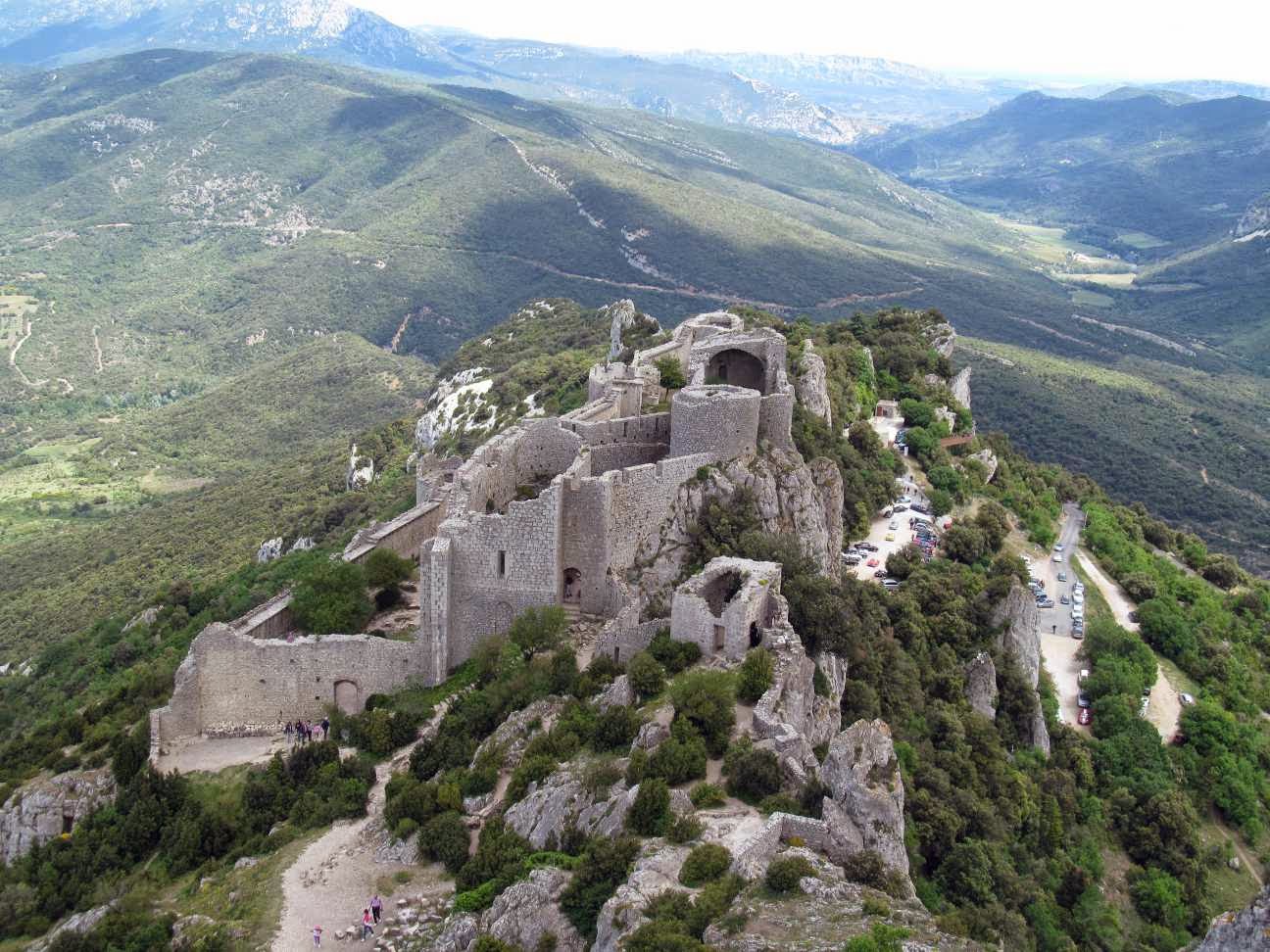
The chateau is one of the most spectacular Cathar fortifications, and it costs EUR 6.50 per adult to visit. This is the upper castle of Peyrepertuse as seen from the lower castle. Even getting to the lower level is already a tiresome climb; getting up there even more so.
But it is so worth it - here is the view of the lower castle from the upper one. Note the many corners of the structure. The builders had to construct it into the rock, making use of whatever space they could find. I wondered in what was labelled the governor's room why there was so much rock on its floor that nobody had chiselled away, and whether the apartment had two maisonette-style levels of wooden floor when the castle was in use.
The second locality we visited were the Gorges de Galamus. If you look closely you can see the is a hermitage built onto the shoulder of the mountain in the middle of the picture. There is a path to the hermitage but we decided we did not have the time to visit it.
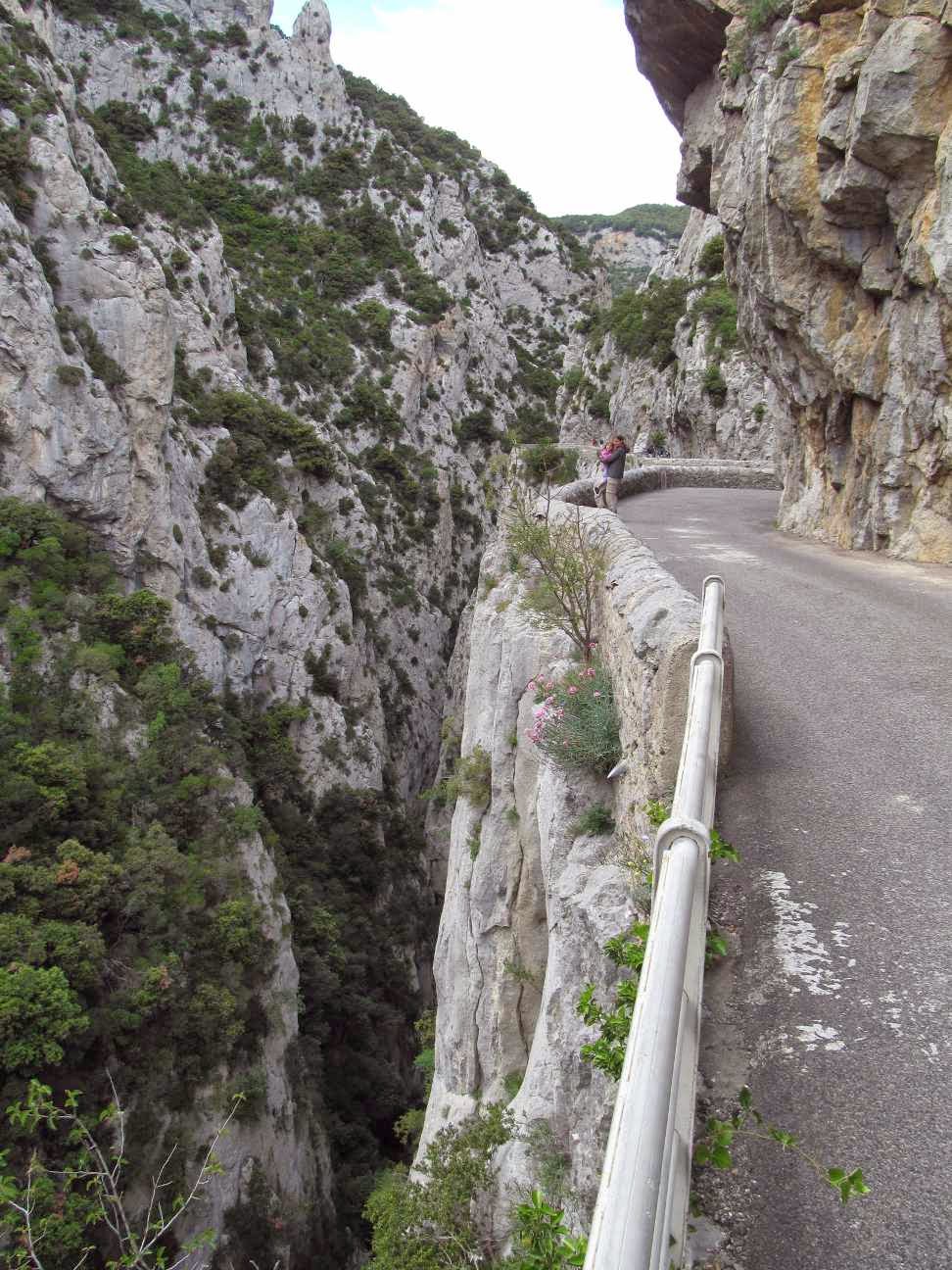
And this is the gorge itself. The tiny figures on the right are my wife and daughter, to demonstrate just how deep and steep the valley is. Unfortunately, a French society of vintage car enthusiasts decided to have their annual meeting in the area, and when we had to pass through the gorge their convoy of dozens of cars came the other way. Which is not something that the gorge can easily accommodate.
(Interesting, by the way, that the people in those vintage cars were nearly all elderly couples, in the driver's seat were always the men and never the women, and they had rather annoyingly smug expressions while driving. I am afraid that extreme car enthusiasts in general are probably not my kind of people.)
This may not be the prettiest plant I could show, but it is of the plant group I work on professionally. Phagnalon sordidum (Asteraceae), a half-shrub of rocky slopes and walls, here seen in the Gorges de Galamus.
The chateau is one of the most spectacular Cathar fortifications, and it costs EUR 6.50 per adult to visit. This is the upper castle of Peyrepertuse as seen from the lower castle. Even getting to the lower level is already a tiresome climb; getting up there even more so.
But it is so worth it - here is the view of the lower castle from the upper one. Note the many corners of the structure. The builders had to construct it into the rock, making use of whatever space they could find. I wondered in what was labelled the governor's room why there was so much rock on its floor that nobody had chiselled away, and whether the apartment had two maisonette-style levels of wooden floor when the castle was in use.
The second locality we visited were the Gorges de Galamus. If you look closely you can see the is a hermitage built onto the shoulder of the mountain in the middle of the picture. There is a path to the hermitage but we decided we did not have the time to visit it.
And this is the gorge itself. The tiny figures on the right are my wife and daughter, to demonstrate just how deep and steep the valley is. Unfortunately, a French society of vintage car enthusiasts decided to have their annual meeting in the area, and when we had to pass through the gorge their convoy of dozens of cars came the other way. Which is not something that the gorge can easily accommodate.
(Interesting, by the way, that the people in those vintage cars were nearly all elderly couples, in the driver's seat were always the men and never the women, and they had rather annoyingly smug expressions while driving. I am afraid that extreme car enthusiasts in general are probably not my kind of people.)
This may not be the prettiest plant I could show, but it is of the plant group I work on professionally. Phagnalon sordidum (Asteraceae), a half-shrub of rocky slopes and walls, here seen in the Gorges de Galamus.
Wednesday, May 28, 2014
Europe day 9: Carcassonne
Another big trip today, this time to Carcassonne. I had been there before, in 1999, but did not remember that it was so big, and then probably did not visit the inside of the castle itself.
The city walls. Although this is the quintessential medieval fortified town, it appears to me that it was rarely useful. After the Roman empire collapsed, the town was conquered by the Visigoths, the Arabs and the Franks. Later, during the aforementioned Cathar crusade, it surrendered to the crusader army. Ironically, one of the rare cases where the fortifications worked was when the Cathar lord tried to retake his castle from the Crusaders a few years later...
City fortifications as seen when entering through the Narbonne gate. There were two portcullises operated from two separate rooms - bribing only one soldier wouldn't work!
This one shows a nice view from the inner castle over the fortifications down to the new city. I particularly like the tower in the centre of the photograph. According to information provided during the tour it dates back to late Roman times as can be seen from its U-shaped foundations: flat towards the town, rounded towards the outside. Also, Roman defensive towers still had larger windows than later Medieval towers.
Another historic town we stopped at is Lagrasse. It has an abbey ruin, but depicted here are a bridge and the outer houses.
On a nature walk near Lagrasse we found this Rutagraveolens angustifolia (Rutaceae) with its intricately fringed flowers. It is a close relative of the traditional aromatic plant Ruta graveolens, and although a herb it is of the same family as oranges and lemons. (Update: Le oops.)
The city walls. Although this is the quintessential medieval fortified town, it appears to me that it was rarely useful. After the Roman empire collapsed, the town was conquered by the Visigoths, the Arabs and the Franks. Later, during the aforementioned Cathar crusade, it surrendered to the crusader army. Ironically, one of the rare cases where the fortifications worked was when the Cathar lord tried to retake his castle from the Crusaders a few years later...
City fortifications as seen when entering through the Narbonne gate. There were two portcullises operated from two separate rooms - bribing only one soldier wouldn't work!
This one shows a nice view from the inner castle over the fortifications down to the new city. I particularly like the tower in the centre of the photograph. According to information provided during the tour it dates back to late Roman times as can be seen from its U-shaped foundations: flat towards the town, rounded towards the outside. Also, Roman defensive towers still had larger windows than later Medieval towers.
Another historic town we stopped at is Lagrasse. It has an abbey ruin, but depicted here are a bridge and the outer houses.
On a nature walk near Lagrasse we found this Ruta
Tuesday, May 27, 2014
Europe day 8: Various ruins
Today we made a trip to the coast to escape the rain. Along the way we went for a short walk in the Garrigue and visited two other sites.
This is the first one, the ruins of the village of Perillos which was deserted about a century ago. Recently work has begun to restore some of the houses such as the one just visible in the upper left corner of the picture, but the atmosphere was still somewhat strange.
Nearby is the ruin of the Chateau de Opoul, here seen from the car park below it. It is much less intact than the previous castle we visited.
Still, the toilet appears to be just as functional as it was hundreds of years ago. But that is probably partly because it is fairly low tech: a hole in a seat jutting out just past the castle wall.
The caste commanded a great view across the valley and towards the Mediterranean Sea. In the background the village of Opoul.
Around the castle I was glad to see Leuzea conifera (Asteraceae) starting to flower. The German name of this low-growing daisy is Zapfenkopf, or cone-head. At first sight it looks as if it might be an apomorphic segregate of Centaurea. Will have to look up if it is actually nested withing that genus.
This is the first one, the ruins of the village of Perillos which was deserted about a century ago. Recently work has begun to restore some of the houses such as the one just visible in the upper left corner of the picture, but the atmosphere was still somewhat strange.
Nearby is the ruin of the Chateau de Opoul, here seen from the car park below it. It is much less intact than the previous castle we visited.
Still, the toilet appears to be just as functional as it was hundreds of years ago. But that is probably partly because it is fairly low tech: a hole in a seat jutting out just past the castle wall.
The caste commanded a great view across the valley and towards the Mediterranean Sea. In the background the village of Opoul.
Around the castle I was glad to see Leuzea conifera (Asteraceae) starting to flower. The German name of this low-growing daisy is Zapfenkopf, or cone-head. At first sight it looks as if it might be an apomorphic segregate of Centaurea. Will have to look up if it is actually nested withing that genus.
Saturday, May 24, 2014
Europe day 4
Walked from Lanet to Mouthoumet and back today and am pretty tired now. Either just not used to it any more or still jetlagged, don't know what.
In Lanet the houses and lanes form an intricate maze. Old French villages can be very charming. Note sunbathing cat on the wall to the right.
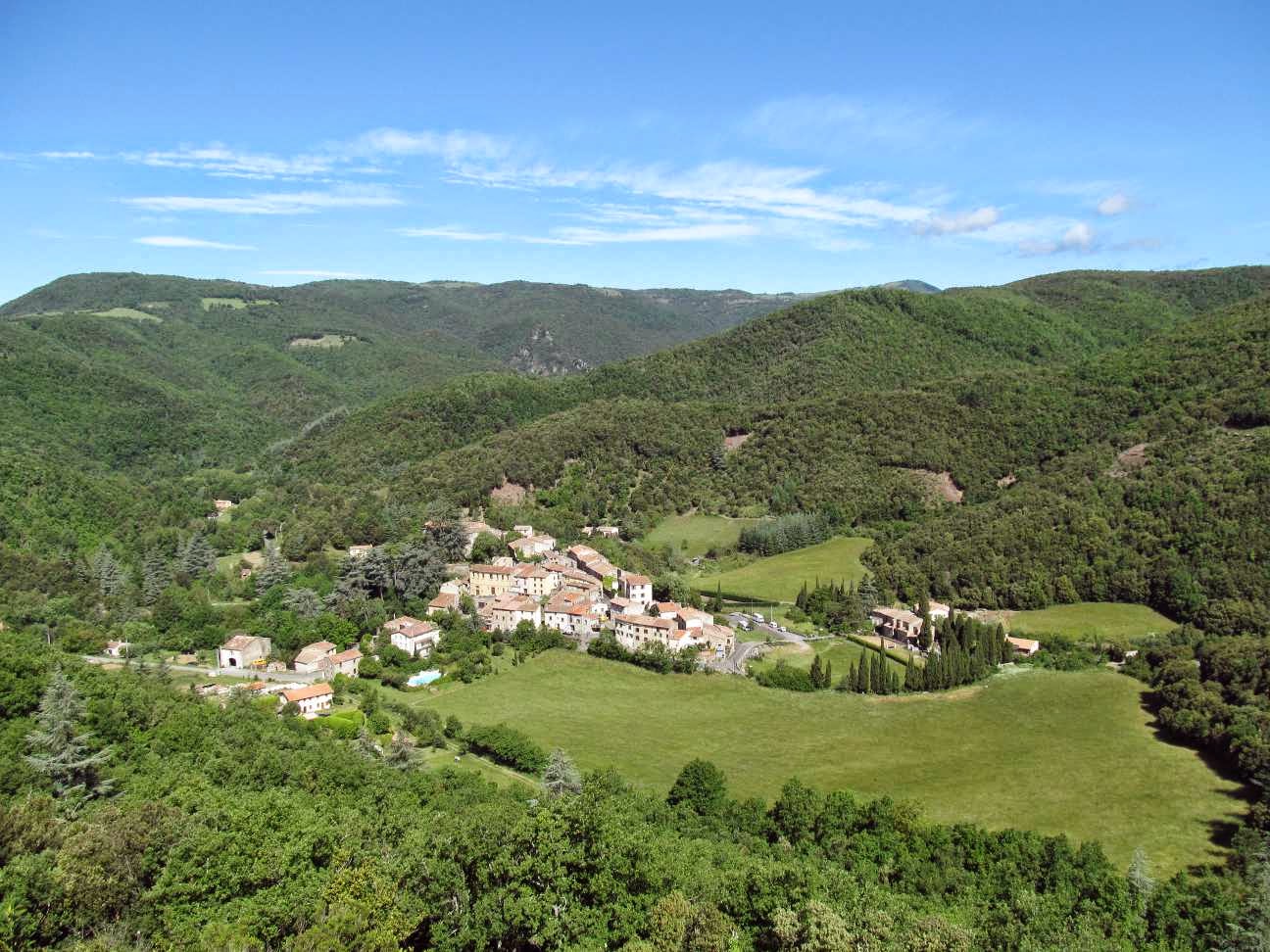
Lanet as seen from above, from the slopes above the village towards Mouthoumet.
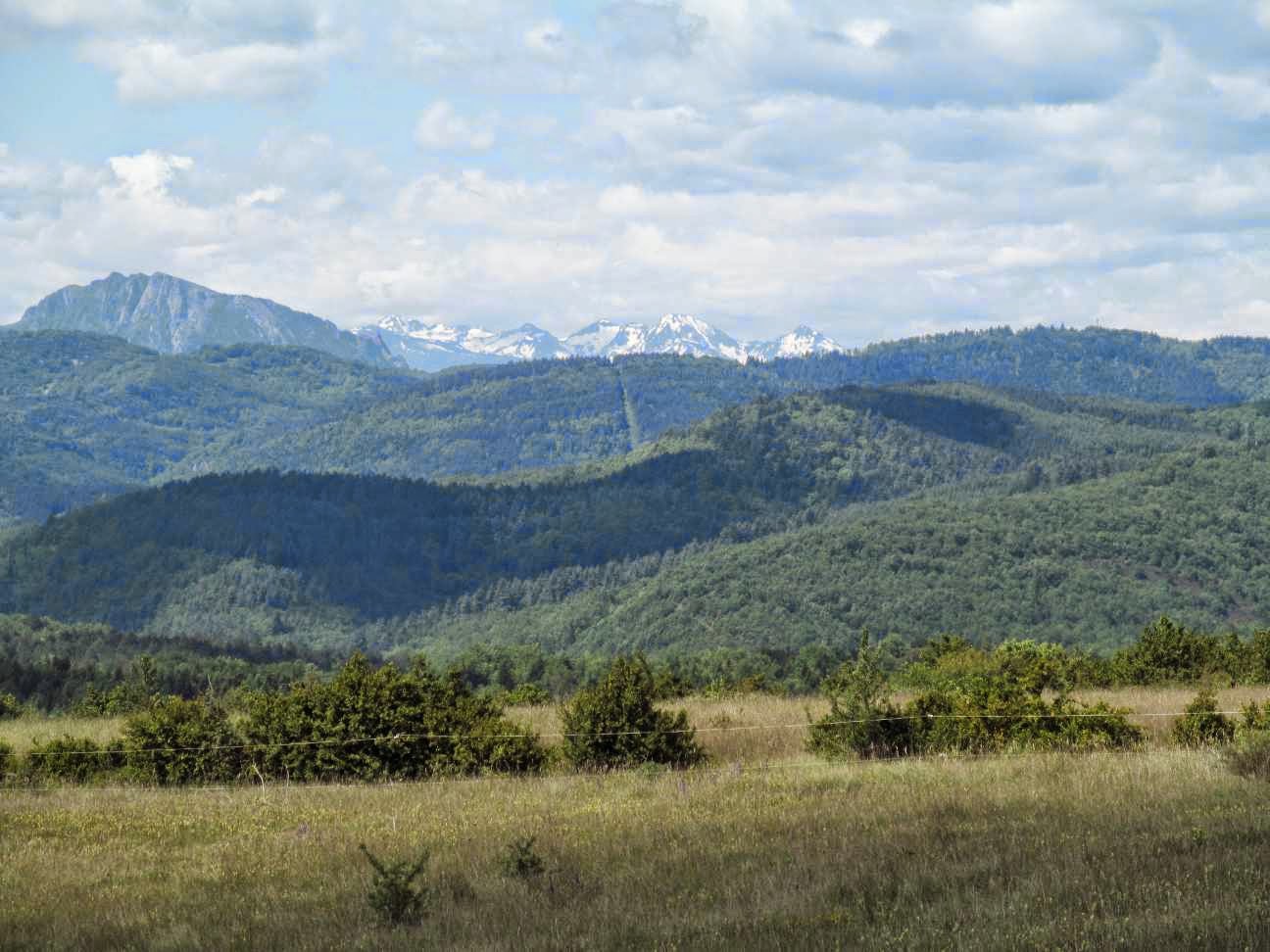
The high plain between the two villages, at approximately 500 m.a.s.l., with a view towards the snow-capped Pyrenees in the distance.
A patch of wild thyme along the way. There were, of course, many more flowers but some of them I don't know the name of yet. I will save them for future botany pictures.
My mother in law made Chevre Chaud yesterday evening. Goat's cheese wrapped in bacon and seasoned with Herbes de Provence, accompanied with seasoned tomatoes. Baked in oven at 220C for 20 min. Served with bread. Simple but delicious.
In Lanet the houses and lanes form an intricate maze. Old French villages can be very charming. Note sunbathing cat on the wall to the right.
Lanet as seen from above, from the slopes above the village towards Mouthoumet.
The high plain between the two villages, at approximately 500 m.a.s.l., with a view towards the snow-capped Pyrenees in the distance.
A patch of wild thyme along the way. There were, of course, many more flowers but some of them I don't know the name of yet. I will save them for future botany pictures.
My mother in law made Chevre Chaud yesterday evening. Goat's cheese wrapped in bacon and seasoned with Herbes de Provence, accompanied with seasoned tomatoes. Baked in oven at 220C for 20 min. Served with bread. Simple but delicious.
Subscribe to:
Posts (Atom)