Showing posts with label silly. Show all posts

Tuesday, October 10, 2017

The world is so confusing sometimes

When will we finally reach peak gibberish in science spam?
Dear Author,
Formatting as in original - an auspicious start.
Journal of Proteomics & Bioinformatics greets you a good day!!!!
That's a new one, but at least it isn't "greetings of the day". Also, by the way, I really don't understand why my spam filter cannot finally figure out that anything that has more than one exclamation mark in a row can be binned immediately.
We are in shortfall of articles for successful release of Volume 10, Issue 10.
See this circle? That is my circle of caring. The fact that this alleged journal cannot fill its issue is about 5,000 kilometers outside of my circle of caring. So...
Is it possible for you to support us with your transcript for this issue before 30th October?
What do they mean with "transcript", which is usually a sheet showing university marks (grades)? Do they not even know the word manuscript?
If this is a short notice please do send 3-4 pages Short Commentary or Mini Review, and hope that a 5 pages article will not take much time for an eminent like you.
What does this sentence even mean? Help?
Also it will be very kind of you if you can acknowledge the receipt of this email and give your opinion to our proposal.
Better not, because if I honestly gave my opinion of their proposal there would have to be some bad language involved.
Best wishes,
Susan Williams
As usual, if this was written by somebody actually called Susan Williams... oh, excuse me, Susan Williams, then I will not only eat my hat but a whole stack of hats.

---

In completely unrelated news, why does GBIF suddenly use hexagons?


This looks as if somebody tries to draw in more people who enjoy strategy computer games, but it seems a bit odd given that spatial studies generally use square grid cells, either equal area or degree-based.

Sunday, February 19, 2017

Bombing of veterans


Did anybody else read this and wonder if bombing veterans in celebration of an anniversary isn't a bit cruel? Writing news headlines is an art.

Another one I always wonder about is the form, "suspect still at large: police". I have yet to understand how the fact that a suspect is still at large can say the word police.

Friday, July 15, 2016

Freedom!

In the light of two more recent rounds of the perennial Free Will discussion elsewhere, I think I now finally understand the incompatiblist position. Let's see if I got this right.

Free Speech. The right to express one's opinion without being punished. Generally considered to find its limits in libel and incitement to violence. In the stricter sense limited to the understanding that the government should not be able to punish a person for expressing their political views; on the other hand it can be argued that free speech in this strict sense alone would be hollow, that expressing an unpopular opinion should not be grounds for losing one's job either. Either way, this concept does not imply anything magic, is perfectly compatible with a deterministic universe, and we are free to say it.

Academic Freedom. Same as free speech but in the context of university employees, particularly tenured professors. Sometimes misunderstood to mean that professors have the right not to do the job they are being paid for without facing any repercussions at all, e.g. when somebody uses what should have been a science course to promote their religious beliefs or political ideology. Most importantly, this concept does not imply anything magic, is perfectly compatible with a deterministic universe, and we are free to say it.

Degrees of Freedom (Statistics). The number of parameters that can vary, that are not determined by others. In many models or statistical tests this number is one less than the total number of parameters, as the value of the last parameter follows necessarily from the values of the others. This concept does not imply anything magic, is perfectly compatible with a deterministic universe, and we are free to say it.

Degrees of Freedom (Mechanics). The number of ways in which a machine can move, counting dimensions and rotations around dimensions. A locomotive for example would have one, a car three (two dimensions and rotation around the third), an aeroplane six. This concept does not imply anything magic, is perfectly compatible with a deterministic universe, and we are free to say it.

Freedom of Religion. The right to practice one's religious faith without being punished for it. Sometimes badly confused with the right to also force others to adhere to the rules of one's own religion or to discriminate against members of other religions. This concept does not imply anything magic, is perfectly compatible with a deterministic universe, and we are free to say it.

Freedom of Movement. Commonly understood to mean the right to move without restriction through one's own country, including choosing one's place of residence, and to leave the country and return to it. This concept does not imply anything magic, is perfectly compatible with a deterministic universe, and we are free to say it.

Free Lunch / Entry / Drinks / etc. Descriptive of receiving a service or item that usually has to be paid for, without having to pay for it in this instance, generally because somebody else pays for it. Funnily enough this concept does not imply anything magic, is perfectly compatible with a deterministic universe, and we are free to say it.

Free Press. The right of the news media to report what is going on without being punished for it. Generally understood to be reasonably limited by the right to privacy and national security concerns. Generally understood to be an important aspect of a functioning democracy, as only a well informed electorate can make well informed decisions. This concept does not imply anything magic, is perfectly compatible with a deterministic universe, and we are free to say it.

Free Range Chickens. Chickens that are, while still obviously fenced in so that they do not escape, given a healthy amount of room to move around, as opposed to "battery" hens. This concept does not imply anything magic, is perfectly compatible with a deterministic universe, and we are free to say it.

Free Fall. The situation in which the only significant force acting on a body is gravity, as opposed to being held up by the ground or being slowed down by a parachute. Even this concept does not, despite having the word "free" in it, imply anything magic, is perfectly compatible with a deterministic universe, and we are free to say it.

Free Style. Being allowed to conduct an activity without having to follow strict rules or being required to achieve a set goal. This concept does not imply anything magic, is perfectly compatible with a deterministic universe, and we are free to say it.

Free Will. The ability to contemplate different possible courses of action and then decide between them in the absence of external pressure or pathological compulsion, resulting in actions that match one's preferences. Despite its equivalence with most of the other terms above, acceptance of this concept (and only of this concept) implies a belief in magic and a rejection of deterministic rules of cause-and-effect. Although a compatibilist view like the one just described was already promoted by the determinist stoics of Greek Antiquity, this view is actually nothing but goal-post moving by unreasonable contemporary philosophers who don't want to accept that neurophysiology has shown determinism to be true. And of course until a few years ago nobody ever had that determinism idea. What stoics? No idea what you are talking about. While we are at it, please ignore all religious traditions that have promoted determinism for hundreds of years because their gods are omniscient; focus on the traditions that have promoted magical, non-determinist Free Will because they were troubled by the Problem of Evil. Using the term even under the non-magical, compatibilist definition given earlier aids them (somehow), so the term Free Will (and only this term, but none of the other equivalent concepts containing the word "free") should not be used any more. Because that is totally going to happen. And when we need to describe the difference between, say, a coldly calculating thief and a kleptomaniac we will come up with something. Perhaps just use "voluntary" and pretend it is not simply the Latin translation of Germanic "out of one's own free will". Or maybe we don't need a word to describe the difference after all, because due to determinism the former had as little choice as the latter; then again, we also believe that there is a difference after all because we would still lock the former up but give the latter treatment, so maybe a term would be useful; then again, due to determinism the former had as little choice as the latter... (Oops, I think I entered an infinite loop there.)

Is that about correct? Bit uncertain about the end, but well, I am not an incompatibilist. There might also simply be different perspectives in the incompatibilist camp.

Saturday, June 18, 2016

Taxonomic terminology again

I have often complained about idiotically unusable identification keys. Unclear descriptions of species are a related issue.

Yesterday I read the description of a daisy and encountered the term 'peracute'. Acute means pointy and is usually understood to mean that the apex of an organ shows an angle of less than 90 degrees (as opposed to obtuse for more than 90 degrees). The most frequently encountered problem is somebody writing 'subacute' to indicate... well, that is a good question. Pointy but not very pointy? And then of course we have issues with some taxonomists using related terms for pointy apices that show some kind of curvature, like apiculate or attenuate, in inconsistent ways.

But I have never before come across peracute. My first reaction was to try and translate it. Again, acute means pointy. Per means through, so through-acute? That does not make any sense whatsoever. A more modern meaning is 'for each', as in twenty kilometres per hour. For each acute? Yeah, not very sensible either.

But wait, I have that old glossary I wrote about in March. But no, sadly it doesn't contain that term either. So really, what is the point if a taxonomist uses a word that simply doesn't exist? Who will understand the description under those circumstances? Wouldn't it be nice if we could define four to six clear and universally agreed-on terms for, in this case, apex shapes, and use them, and only them, consistently?

Ah well. At least I had the opportunity to peruse the glossary again. And of course peracute is nothing. This book is the mother lode of bad ideas.

Pampinus - n. Tendril.
Then why not write tendril? Ye gods.

Panduriform - a. Fiddle-shaped.
Then why not... oh, we had that already.

Parastomon - n. An abortive stamen, a staminodium.
You know, we already have a word for that. It is 'staminodium' or 'staminode'.

Phoranthium - n. The receptacle of the capitulum of Compositae.
Ah, I have heard of that structure, only everybody calls it a ... receptacle.

Argh. Argh. Argh. Argh. Headdesk. Are some people actually deliberately trying to make their taxonomic publications pointless, useless and maximally infuriating?

Friday, April 15, 2016

Modern art or something


I am currently re-counting some photos of root tip squashes for a paper I am preparing, and I stumbled across this photo taken by the student who was working with me. Seems like the exposure was somewhat off, but I find the result actually quite interesting.

The thin area was air caught under the cover, the surrounding larger areas were liquid.

Unfortunately it seems as if the photos we haven't counted yet were largely left over for a good reason: they can't really be counted with confidence. Sigh.

Saturday, March 12, 2016

Unnecessarily arcane botanical terminology

Sometimes the personal libraries of retired colleagues who want to downsize, or other left-over old books, are made presented in the corridor of our herbarium so that staff can pick what they still find useful. I have in this way acquired a number of valuable books, especially old Australian or New Zealand floras.

Recently I have in the same way picked up a book with great (unintentional) entertainment value. It is Taxonomic Terminology of the Higher Plants by H. I. Featherly in a 1973 reprint of the 1959 edition, published by Hafner Press. In case it isn't immediately clear, it is mostly a glossary of botanical terminology. To illustrate what is so funny about it, let's open the book randomly on pages 62 and 63 and look at a few selected entries just from this double page. Blue text is from the book, black font are my comments.

Thursday, December 17, 2015

Fun with trendline charts

Via Pharyngula I was recently lead to an American blog that had produced the following chart of average annual global temperatures, apparently in an attempt to demonstrate that we need not worry about the greenhouse effect:


This is just so totally awesome, I thought I would do a few myself. First, did you know we don't need to worry about overpopulation either?


Indeed there is absolutely no population growth at all! Next, watch my daughter grow up:


Finally, I tried my hand on one of those Kurzweilian charts of exponential technological progress:


Seems like we won't see a technological singularity any time soon. Checkmate, futurists!

Saturday, August 8, 2015

Field trip to Kioloa

After the recent reconnaissance trip to the Australian National University's Kiola Coastal Campus, I am currently on the student field trip that we were then preparing for.


The weather is perfect for bush walking as well as photographing. The above picture shows part of the Coastal Campus with several of the cottages in the background that are used for accommodation, teaching and research.


Today we spent most of the day in the forested two thirds of the campus. Above a picture taken in the rainforest part. The rest of the day was then spent identifying plants and preparing student talks.


Baeckea virgata (Myrtaceae), a little tea tree relative. Similar to Leptospermum (the proper tea tree genus) but with smaller flowers and fruits.


Hakea (Proteaceae) "pods", really follicles, with an insect's egg casket cunningly hidden on them; note how the colour blends in nicely. Probably the egg casket is a praying mantis' ootheca. This was discovered by one of the students.


Australian Health and Safety procedures: This picture shows an evacuation plan for a cottage with four rooms, a single straight corridor and an exit at either end. I strongly suspect that if I were too panicked or confused to figure out on my own how to flee from such a simple building I would certainly be too confused to read the plan.


Also, "coloured chopping boards for your health and safety". Truly I have never seen something like this before, and one immediately wonders how the people fifty years ago (or 5,000 years ago) managed without colour coded chopping boards.

Wednesday, June 24, 2015

Fun with scientific plant names

Long time no blog; not enough ideas what to write, too much else to do.

Just went through a big dataset of Asteraceae (daisy or sunflower family, also known as Compositae), and I realised how many silly scientific genus names there are. Some of the highlights:

Pseudobahia, Pseudoclappia, Pseudoconyza, Pseudohandelia, Pseudonoseris, and Pseudostifftia are, of course, all based on similarity to genera with exactly the same names only without the Pseudo-.

Similarly, I feel that Senecio, Dendrosenecio, Nemosenecio, Parasenecio and Sinosenecio betray a certain, let us say, lack of imagination in naming members of the Senecioneae tribe.

Erato sounds odd but was apparently one of the Ancient Greek Muses. No idea whether the genus Oblivia has a similarly defensible etymology though.

Damnxanthodium is perhaps the best. Xantho- means yellow, and as can be imagined 'damn' is neither Ancient Greek nor Latin. It is an obvious reference to the American abbreviation DYC, which stands for Damn Yellow Composite, in other words the complaint about so many of them looking pretty much alike. A zoologist counterpart is apparently LBB for Little Brown Bird.

Monday, September 1, 2014

Waterfalls, this time with actual falling water

A few weeks ago I went to Jervis Bay with ANU lecturers and students for the third time. I always wanted to show the area to my family, and this weekend we finally managed to go camping there. My wife enjoyed the native plants and animals, my daughter loved the beach, and both admired the landscape.


On the way there, we stopped at Fitzroy Falls in the Moss Vale area. This impressive waterfall is 81 m deep, but as can be seen in the above picture there was quite a lot of fog so we could not see it under ideal conditions. This place is really wet most of the time, the vegetation is pretty much a temperate rainforest.


On the way back, we also stopped at the same place as I did with the student field trip - Tianjara Falls. Then I called it an alleged waterfall because it was dry, but this time we were rewarded with a much nicer view! For some time there was even a rainbow in the spray.


To end on a somewhat weirder note: The family posing in front of the Big Merino of Goulburn. These various big whatevers of Australia are of course greatly amusing to a five year old, but I wonder what archaeologists of the future are going to make of a megalithic sheep. If it can still be reconstructed after two thousand years it will probably be assigned some kind of religious significance. Then again, I doubt that a structure like this one will last as long as Roman masonry.

Wednesday, June 4, 2014

Goodbye France, hello Germany

The first part of our trip is over, tomorrow we will travel to northern Germany. Time to have a last look at pictoresque south-western French towns.


Towns in which you can buy pain at a corner store...


...and towns in which there are terror houses on the town square.

(Okay, in that case I cunningly hid an "i" behind the lamp-post. Still, terror is the first thing my brain makes of these signs even when that letter is visible.)

Friday, February 21, 2014

Why we are not getting killed by SkyNet any time soon

Computers are dumb.


For the benefit of non-German readers, this is a screenshot of the German Yahoo News site. The second paragraph starts with the phrase "the process initiated by her predecessor...", with the German word "der" being the direct counterpart of English "the" (for male nouns, that is, but let's not make this complicated).

Behind the German "the", some script has automatically inserted a share price at the Chinese stock market and a link to more stock market information. Why? The prominent box on the left provides the answer. It is not related to the article, which is not about stock markets at all but about the ministry of defense, nor is it some paid advertisement. Instead, the box has been added by the very same script, and it shows the recent development of share prices for a company called DER.

DER; "der Prozess". Get it?

It would be funny if it weren't so sad. (And annoying; let's not forget how annoying it is to have some stupid script clutter every text that contains the male definite article with irrelevant graphs and links).

And this is one of many reasons* why I am not afraid of a so-called technological singularity turning into Terminator: Rise of the Machines. Computers are idiots. Yes, they can do amazing things, but they are "oh look, she is trying feed herself with a spoon now, and most of it ends up in her lap, isn't that cute" amazing things, not "she is the greatest physicist of her generation" amazing things.

Of course, the computer is not really at fault, it is only a tool. Really one has to wonder about whoever wrote this script and thought it would be a great idea.

*) The other reasons are mostly variants on the observation that the singularity itself is a ridiculous idea.

Wednesday, August 28, 2013

Lab equipment


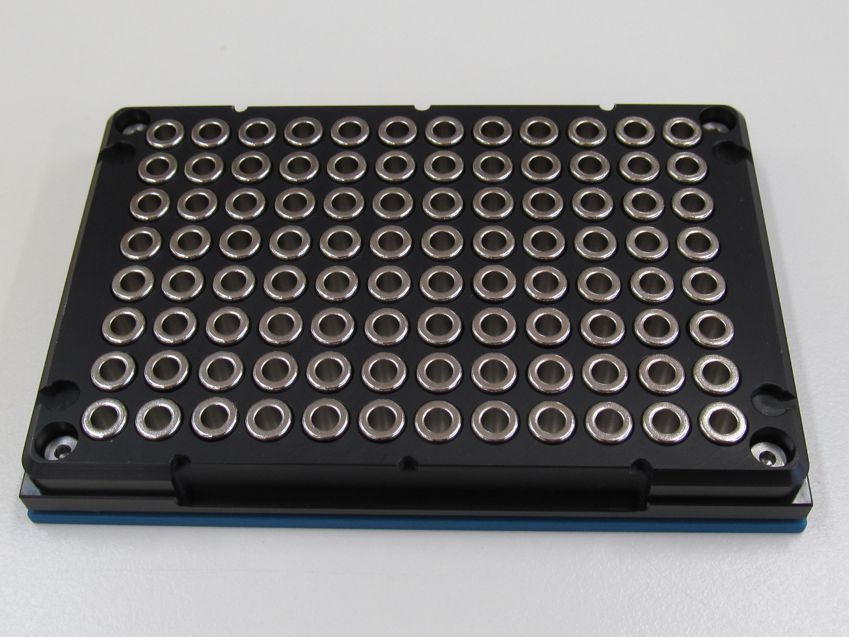
Recently I bought a shiny new piece of lab equipment. It is essentially a strong neodymium magnet with 96 holes, so that you can place a 96 well reaction plate in it.

It is used in DNA purification: You bind the DNA in the wells of the reaction plate to tiny metal beads, place the reaction plate on the magnet plate and presto! within seconds the beads are drawn to the walls of the wells. Now you can remove the liquid that contains everything but the DNA and the beads, wash the well, and then put pure water or elution butter in each well. You remove the reaction plate from the magnet, let the DNA go back into solution, and then you use the magnet once more to separate the metal beads from the water which now contains your cleaned DNA.

Two things are remarkable about this magnet plate. The first is how heavy it is compared to its small size (and considering the fact that a lot of it is holes). If you pick it up, you really have something in your hand.

The second is the product description slip that came with it. Because this magnet is really super strong, it contains a lot of colourful warnings:
Individuals with pacemakers or implantable cardioverter-defibrillators should avoid contact with this product.
Not surprising. I remember that the university where I studied had entire corridors with warning signs telling people with pacemakers to keep out because strong magnets were being used.
Do not allow the unit to come in contact with metal objects or other magnets. Damage will occur to magnetized media, such as diskettes or credit cards, near the plate. Damage will also occur to computers and CRT-based monitors near the magnets.
Unsurprising again, and clearly I will not use it on a bench where we have cyclers or other expensive equipment.
Under no circumstances should two magnet plates be allowed to "snap" together; the magnets are strong enough to cause injury and separating them is almost impossible.
In other words, anybody having fingers between two of those plates would find reason to regret it. However, I would assume that most average labs do not need more than one of these plates anyway.

Obviously this item needs some thoughtful handling. But at the moment I am mostly impressed by the strength of its magnetic field - and by the fact that we measly humans are able to manufacture something like it.

Tuesday, August 20, 2013

Optical pollution in Canberra

Clearly there things that are better in Germany and things that are better here in Australia. For example, the German three-tiered school system is very embarrassing to explain, and I much prefer the simple Australian Medicare to the convoluted health insurance system we have in Germany.

One thing I really dislike here are, however, these stupid posters that are perennially lining the streets:


They are set up by real estate agents to advertise flats or houses for sale or rent. Here are seven of them in one place because there is a complex with many individual flats nearby, and a few of them are always vacant. What is more, the agents have a tendency to let them stay in place even weeks after the deal has been done, often with a "sold" sticker prominently added to them, to maximize the time their company name can adorn the sidewalk.

Believe it or not, in Germany we have these things called "classified ads" and "the internet" (shocking, I know), which mean that nobody has to set up posters to advertise the same information in a much less efficient but much more obnoxious way. And somehow people coming to see the vacant flat appear to be able to find it by writing down the address instead of expecting a poster in front of the property in question. Posters like those above do not appear to exist in Germany.

All of that means that outside of election times German streets are generally not plastered with garish posters, while Australian streets are, constantly.

Saturday, June 29, 2013

Overly honest methods

Just got sent a link by a colleague. It's hilarious, check it out. The one with "reviewer 1" might be my favorite, as you can imagine.

Tuesday, April 9, 2013

This science spam is getting ridiculous

There was a time when all the spam e-mails I received were the normal, mundane kind, advertising sildenafil citrate, websites supposedly showing pictures or movies of people without their clothes, bargain watches, and of course deals on the lines of "I am the widow of a Nigerian banker and I will send you $4 million if you send me $10,000 first".

That changed, if I am not mistaken, when I participated in one specific conference in 2011. The organizers must have put the details of all participants, including their work e-mail addresses, onto the web and from there they must have ended up in the mailing lists of scientific spammers. This type of spam has been mentioned on this blog before - e-mails inviting the recipient to register for some for-profit conference or a predatory for-profit online only journal. The latter are more often than not willing to "publish" whatever nonsense you send them in exchange for a fee. The blog Scholarly Open Access helpfully documents their dubious practices, including a recent not entirely surprising case in which an open access journal simply disappeared, deleting all the articles authors had paid for to get "published" there. Really, don't waste your manuscripts on outfits like these.

Anyway, I feel that these spam e-mails are getting ever more frequent and stupider. Here are just three from the last few days, indeed two of them appeared in my inbox only today.

Monday, December 24, 2012

Happy holidays!

Got this from another blog, but unfortunately I don't remember where and when. Blogging is going to be sporadic until the new year.