Wednesday, January 15, 2014
Botany picture #131: Acacia verticillata
Acacia verticillata (Fabaceae), Tasmania, 2013. Like many Australian Acacias, this one has reduced its ancestrally bipinnate leaves to phyllodes which are merely flattened and expanded petioles. While the diversity in phyllode morphology is stunning, the diversity in flowers and inflorescences in this large genus surely isn't. Basically, they come in yellow and (more rarely) white and in round heads or (more rarely, as in the present case) elongated spikes.
Monday, January 13, 2014
Fairley & Moore's Native Plants of the Sydney Region
During our recent trip to the Blue Mountains I made some use of Fairley & Moore, Native Plants of the Sydney Region. The positive aspects first: It is most helpful for quickly identifying plant species, at least if you already have a bit of an idea of where to start looking, and allowed us to easily figure out what Grevillea or Persoonia we had just run into. I appreciate very much that the plant groups are arranged in a systematic fashion instead of alphabetically as in some other guides I could mention.
More generally speaking, although I need more sophisticated keys for my actual work I love field guides like these, especially of areas I have never had the chance to visit. At home we have, for example, a guide to the Fynbos flora that was kindly brought back from a visit to South Africa by a postdoc during my time in Switzerland and a guide to the flora of Kazakhstan that was a present from a PhD student in Germany. I cannot actually read the latter except for the Latin plant names but I still enjoy having it.
Using the Sydney Region one really for the first time now, however, it occurs to me that this particular specimen of the genre has a few problems from a scientific perspective. For all the following points, note that what I have is the 'revised third edition published in 2010' so it is not as if the book has the excuse of being terribly old.
More generally speaking, although I need more sophisticated keys for my actual work I love field guides like these, especially of areas I have never had the chance to visit. At home we have, for example, a guide to the Fynbos flora that was kindly brought back from a visit to South Africa by a postdoc during my time in Switzerland and a guide to the flora of Kazakhstan that was a present from a PhD student in Germany. I cannot actually read the latter except for the Latin plant names but I still enjoy having it.
Using the Sydney Region one really for the first time now, however, it occurs to me that this particular specimen of the genre has a few problems from a scientific perspective. For all the following points, note that what I have is the 'revised third edition published in 2010' so it is not as if the book has the excuse of being terribly old.
Saturday, January 11, 2014
Von den Blauen Bergen kommen wir...
The last two days I was on a field trip to the Blue Mountains with a colleague and several students. We were mostly searching for the rare and remote 'pagoda daisy' Leucochrysum graminifolium (Asteraceae), a habitat specialist and local endemic of the area north of Lithgow.
This is the habitat: twisted and weirdly shaped sandstone rocks sticking out of the forest. The place was unexpectedly awesome; I came there expecting simply rocky mountain slopes along the road.
Many of the rocks are clearly layered, and often a higher layer is wider than the layer immediately below it. Together with the stair-like appearance of the rock formations this invites a comparison with Asian pagoda style buildings. At any rate, a nearby national park is called Garden of Stones, surely because the strange rock formations are its major attraction.
And we found it! The paper daisy we were searching for grows directly on the rocks, sometimes in cracks, sometimes on a minimal layer of decomposing leaf litter. The individual specimens often have many dead leaves and substantial rootstocks, indicating that once they have managed to occupy one of the few suitable sites on the rocks they do not carelessly give it up again by having a short life cycle. These plants are much more long-lived than most of their congeners.
This is, of course, the more typical kind of Blue Mountains landscape, seen here from Echo Point Lookout in Katoomba, where we stayed the night.
And finally, another Blue Mountain endemic, Grevillea laurifolia (Proteaceae). It is very easy to recognize because it is prostrate, and other prostrate Grevilleas generally have divided leaves.
This is the habitat: twisted and weirdly shaped sandstone rocks sticking out of the forest. The place was unexpectedly awesome; I came there expecting simply rocky mountain slopes along the road.
Many of the rocks are clearly layered, and often a higher layer is wider than the layer immediately below it. Together with the stair-like appearance of the rock formations this invites a comparison with Asian pagoda style buildings. At any rate, a nearby national park is called Garden of Stones, surely because the strange rock formations are its major attraction.
And we found it! The paper daisy we were searching for grows directly on the rocks, sometimes in cracks, sometimes on a minimal layer of decomposing leaf litter. The individual specimens often have many dead leaves and substantial rootstocks, indicating that once they have managed to occupy one of the few suitable sites on the rocks they do not carelessly give it up again by having a short life cycle. These plants are much more long-lived than most of their congeners.
This is, of course, the more typical kind of Blue Mountains landscape, seen here from Echo Point Lookout in Katoomba, where we stayed the night.
And finally, another Blue Mountain endemic, Grevillea laurifolia (Proteaceae). It is very easy to recognize because it is prostrate, and other prostrate Grevilleas generally have divided leaves.
Tuesday, January 7, 2014
SeaView
As mentioned in my last post, I have recently stumbled across a really great and handy software tool for molecular phylogenetics. When installing programs on Linux, I sought for an open source alternative to the sequence alignment editor BioEdit that I have been using on Windows since I was an undergrad. The one I found, SeaView, may in some regards be even better.
Sunday, January 5, 2014
Weekend trip to Deua NP; Ubuntu
This weekend, as always this time of the year, our suburb was full of inebriated, heavily tattooed man-children who believe that loud noises and inhaling toxic fumes are the most sublime forms of entertainment ever invented, and so we fled the city and went camping in Deua National Park. I have already written about one of its main attractions (the Big Hole), and we went back to the same place, so I do not have much to add.
The Shoalhaven River is perfect for a four year old as it is slow moving and not too deep. We had a great time there both Saturday and Sunday afternoon.
The heath on the way to the Big Hole. As my wife commented, "in Germany you would see two towns and three villages in that direction." One of the main attractions of this country is its relative emptiness due to low population and a high degree of urbanization.
Persoonia (Proteaceae). This genus is a bit different from most other Australian Proteaceae in that it has fleshy fruits - at least some are edible - and apparently lacks the cluster roots that enable other members of the family to survive on very poor soils.
And a Fabaceae whose name I should know because I already saw it in 2010, but it escapes me at the moment. Whatever its name, its combination of Holly leaves and typical pea flower are extremely odd from a Central European perspective...
---
Our adventures with Ubuntu continue:
The Shoalhaven River is perfect for a four year old as it is slow moving and not too deep. We had a great time there both Saturday and Sunday afternoon.
The heath on the way to the Big Hole. As my wife commented, "in Germany you would see two towns and three villages in that direction." One of the main attractions of this country is its relative emptiness due to low population and a high degree of urbanization.
Persoonia (Proteaceae). This genus is a bit different from most other Australian Proteaceae in that it has fleshy fruits - at least some are edible - and apparently lacks the cluster roots that enable other members of the family to survive on very poor soils.
And a Fabaceae whose name I should know because I already saw it in 2010, but it escapes me at the moment. Whatever its name, its combination of Holly leaves and typical pea flower are extremely odd from a Central European perspective...
---
Our adventures with Ubuntu continue:
- The GUI does not allow us to change access rights to files. Yes, we could perhaps do that in the terminal but the point is, it should.
- The Privacy tool does not allow us to delete the history. Yes, we could perhaps do that in the terminal but the point is, it should.
- Skype crashes whenever one of our contacts goes online, whenever one of our contacts goes offline, and whenever we answer a call. We can call others though.
- TreeView X, one of the most widely used phylogenetic tree viewers, crashes whenever I try to open a tree. FigTree, an alternative tool for the same purpose, does everything it should except, strangely, converting a tree into a graphic. On the plus side, I found an absolutely awesome freeware program that I may blog about in a few days.
- The virus scanner is very paranoid and considers many harmless files to be threats, including even a few short executables that I programmed myself for a work project in 2012, and they do nothing but write large amounts of randomized data into a text file.
Friday, January 3, 2014
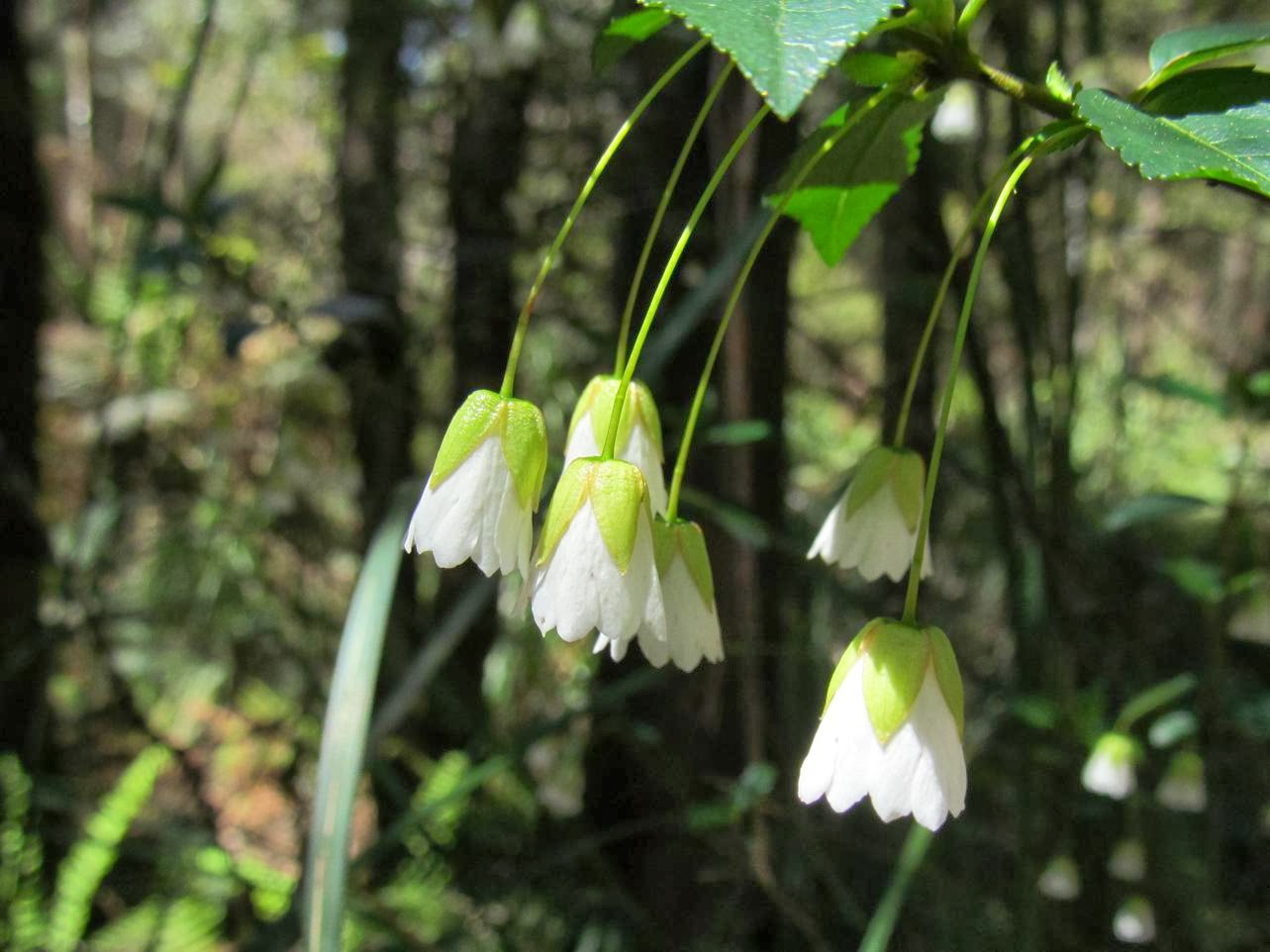
Botany picture #130: Aristotelia peduncularis
Aristotelia peduncularis (Elaeocarpaceae), Tasmania, 2013. This plant was one of the few disappointments with the online key I have mentioned previously. Although I knew all the traditionally important characters like its flower formula, and although it is extremely distinctive (opposite leaves, and the petals are three-lobed!), I got nowhere. A colleague from the Tasmanian herbarium told me the name of the species when I showed him this picture. An attractive shrub growing in the western rainforests of the island.
Wednesday, January 1, 2014
Happy New Year
The fireworks in Canberra centre, last night. That was nice, and the first firework our daughter has seen.
---
We bought a new computer a few days ago. So far I have perennially been a resigned Windows user - simply because it always seemed to be more trouble installing Ubuntu than dealing with the default operating system, and because I was used to Windows. In other words, laziness.
Boy, did Windows 8 ever change that calculation.
Yes, Ubuntu also has got a few issues, and the newest Microsoft atrocity sure makes it extremely difficult to install it (this is what saved me there), but Windows 8 is simply infuriating in a way that none of the previous versions was. Using it for two minutes at a time flips me into an incoherent rage. Also, Ubuntu is fast, more elegant, more intuitive and much safer.
In other words, I have got enough. At work it is still Windows, but if the IT people ever migrate us to 8 that will also have to change.
Subscribe to:
Posts (Atom)